Design Systems Canada: Enhancing Product Design & Performance Using FEA Simulation
May 12, 2026
How Utilizing FEA Simulation Can Help You Reduce Risks & Lower Costs
Waiting until a physical prototype fails is an expensive mistake. At Design Systems Canada (DSC), they help their partners avoid these setbacks by using advanced digital testing.
One of the most valuable tools in their arsenal is Finite Element Analysis (FEA). While it sounds technical, its purpose is simple. It allows them to predict how a product will react to real-world forces before it ever leaves the computer screen.
What is FEA Simulation?
The core principle of Finite Element Analysis (FEA) is “divide and conquer.”
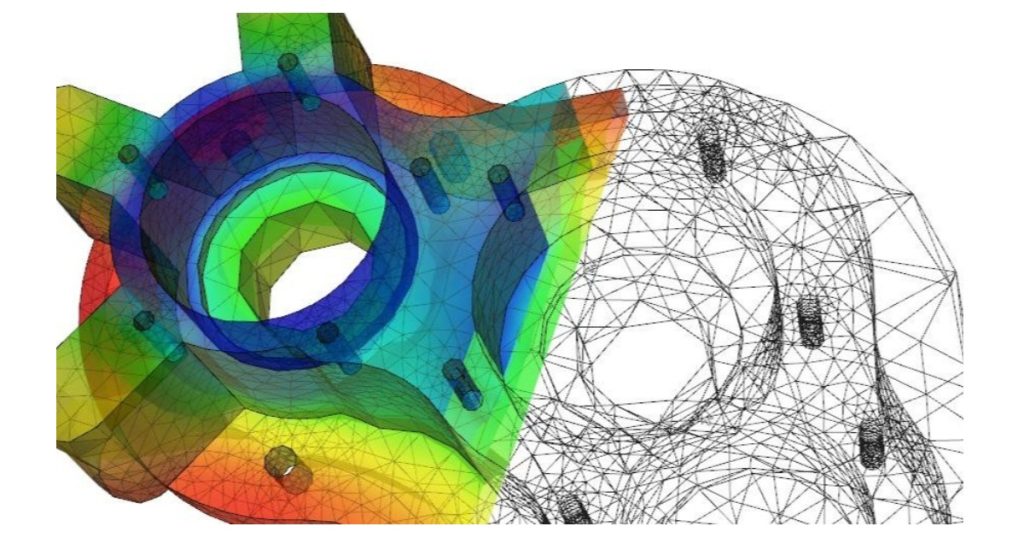
Instead of trying to calculate how an entire, complex machine part will react to a heavy load all at once, FEA software breaks the object down into thousands of tiny, manageable pieces called “elements.” These elements are connected at points called “nodes,” forming what engineers call a “mesh.”
By applying mathematical equations to each individual element, the software simulates how the entire structure will behave when pushed, pulled, or heated.
The Power of Virtual Testing
Using FEA simulation provides a “virtual laboratory” where they can test designs to their breaking points without wasting a single piece of steel. Here is why this matters for your project.
- Stress and Structural Analysis: DSC can pinpoint exactly where a part is likely to bend or break. This allows them to strengthen weak points or remove unneeded material from over-built areas, optimizing the design for both strength and weight.
- Performance Optimization: By simulating different materials or shapes, they can find the perfect balance for your specific application, whether you are designing a warehouse rack or a high-speed conveyor component.
- Faster Time-to-Market: Traditional design often involves a cycle of “build, break, and rebuild.” With simulation, they can run dozens of iterations in the time it takes to manufacture one physical part.
Cutting Costs & Increasing Reliability
The financial benefits of simulation are clear. According to industry studies, companies that use simulation early in the design phase can see a 50% reduction in prototyping costs.
Consider a scenario where a manufacturer is developing a new heavy-duty lifting fixture. Without FEA simulation, they might build three different physical prototypes at $10,000 each to test durability.
If the third one fails during a live test, they are back to the drawing board with $30,000 lost.
With DSC’s expertise, they can simulate those tests digitally, catching the failure in the software, fixing the design, and moving straight to a final, successful prototype. This not only saves money but ensures the final product is significantly more reliable.
Why Software & Expertise Matter
While modern FEA software is incredibly powerful, it is only as good as the engineer operating it. Setting up the right “boundary conditions”—the digital version of gravity, friction, and force—requires deep technical knowledge.
At Design Systems Canada, their team of licensed engineers combines decades of experience with the latest simulation technology. They don’t just provide a report; they provide a roadmap for manufacturing excellence. Whether it’s ensuring compliance with Ontario’s safety codes or optimizing a global supply chain, their focus is always on your success.
Ready to Optimize Your Design?
Don’t leave your product’s performance to chance. Let Design Systems Canada help you reduce risks and lower costs through expert Finite Element Analysis.
Contact DSC today to discuss your next project or visit their website to learn more about Design Systems Canada’s full suite of engineering and Industry 4.0 solutions.


FEA Simulation FEA Simulation