Utilities: It’s Time to Re-evaluate Headlamp Specifications
February 18, 2022
For utility workers such as linemen maintaining electrical lines or natural gas infrastructure one of the most critical, yet undervalued, tools of the trade have been headlamps. In low light conditions, these essential tools enable technicians to clearly view the task and surroundings under bright light while freeing up both hands. Unfortunately, utility linemen are often restricted to purchasing products through preferred distributors based on specifications that were established many years ago.
Usually, the fact that the specifications could be a decade or more old is given little additional thought. Once established, there is little to trigger a re-evaluation except perhaps the worst-case scenario – an injury or fatal accident. In many cases, change only occurs due to the effort of a lineman that comes across a better product and “champions” it within the utility, or a safety committee responds to a major revision of the safety requirements. All too often, these are happy accidents, rather than a proactive review of the specifications.
Still, there is much to be gained by re-evaluating the standards for headlamps. Outdated specifications may not incorporate the most recent safety advances for hazardous environments. The specifications often do not utilize technological innovations that significantly extend battery life and provide brighter light including the latest developments in LEDs. Older technologies still in the specifications, such as incandescent bulbs, may actually cost more than newer options.
Re-evaluating headlamp specifications can also have a significant payoff in improved safety features, brightness, and battery life. For operators in the field, this translates into the ability to perform safer, more efficient maintenance and repair without frequently having to change out batteries during their work shift.
Today’s intrinsically safe headlamps are also specifically designed not to be a source of ignition in hazardous zones, which can have flammable gases, vapors, materials, or dusts in the environment or in the air. In these settings, having a headlamp that does not generate a spark is essential to protect life, property, and utility reliability.
Although a headlamp utilized in an electrical setting may require certain safety ratings, different ratings may be required in a gas environment. When this occurs, purchasing a product designed to be intrinsically safe in both environments can be the safest option. This also prevents any risk when linemen share products and tools with others.
The Path to Specifying Better Product
There are various ways that a re-evaluation of the existing headlamp specifications can occur. Often a lineman, safety committee member, or purchaser discovers a better product and recognizes its value. They usually find products like headlamps and flashlights through manufacturer sales representative in person demonstrations, online searches, referrals, tradeshows, or by reading industry trade publications. When evaluating products, linemen are often drawn to products with brighter illumination and longer battery life to reduce battery changes.
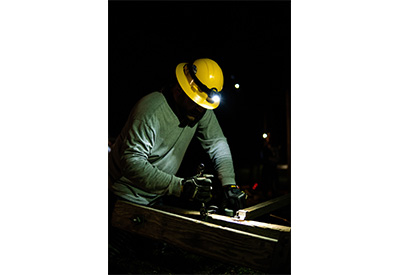
“A specification may be for 100 lumens for X number of hours when 400-lumen lights are now available, so the spec needs to be updated,” says Cash. He notes that some utility headlamps are designed to provide 420 lumens in high spotlight mode while lasting up to 100 hours in low floodlight mode.
Battery life is an important consideration because utility linemen working 8 to 12 hour shifts in bucket trucks prefer to avoid the downtime descended from the line to change out headlamp batteries two or three times per shift. Today, advanced LEDs with lower battery draw, less heat, and greater illumination per unit of energy can enable battery power to last entire shifts without a change.
As for safety committee members, the focus in the specifying process is increasing safety and minimizing the risk of injury or potential liability. Re-evaluation may require getting samples and conducting field trials prior to approval.
Safety committees must also consider all the potential environments a utility lineman may work in, including above and below ground as well as in enclosed spaces. For this reason, it is important that they use equipment that is intrinsically safe in any potential worksite.
“A safety committee for an electric utility may not initially think a Class 1, Division 1 intrinsically safe headlamp is required because the operator is typically not in a location where gases, vapors, or liquids that are potentially flammable exist. But the larger electric companies often service equipment underground where hazardous gases like methane can accumulate. The utility never knows exactly what work the lineman will be doing underground on any given day – and a gas meter alone may not provide sufficient safety,” says Cash.
“So, in production, service, or maintenance settings where personnel may be exposed to an inherently volatile conditions, headlamps should carry the proper certification for various classes, divisions, and groups of materials. When a headlamp is rated for all these options, it essentially means it is certified as safe for use in most hazardous environments,” adds Cash.
As one example in the industry, the intrinsically safe Vizz II headlamp by Princeton Tec, meets essentially all safety requirements whether for OSHA, Zone 0, or state standards (Classes I, II, III; Divisions 1,2; and Groups A-G). So, there is nothing from the lighting that could spark a potential fire or explosion in a work environment.
The latest models also offer anti-static properties and safety features, such as a mechanical locking mechanism that requires a tool to open the battery compartment. This prevents users from inadvertently opening the battery housing in a hazardous environment, which could not only result in electric shock, but also potentially ignition or explosion.
Besides linemen and safety committee input, the utility’s purchasing department is also typically involved in the specifying process. Purchasers usually focus on attaining lighting products that meet all necessary specifications at the lowest cost.
In this regard, as LED lighting increases in production volume and market share, the volume of older, more traditional options continues to shrink and become more costly to manufacture in comparison.
Although U.S. manufactured headlamps with the most advanced LEDs are still slightly higher in initial purchase price, the total cost of ownership is considerably less if the cost of frequent battery replacement is factored into the calculation.
Outdated specifications can remain in place simply because it can take some effort to change the status quo. To avoid missing out on the benefits of using substantially improved, safer equipment, Cash suggests that decisionmakers re-evaluate the existing specifications toward the end of any utility contracts for existing products.
“A good time to re-evaluate a utility’s equipment options is when their contract for a certain product is over. This allows testing and quoting other potentially superior products that have taken advantage of industry advancements in the interim,” concludes Cash.
If no contract is in place, and the specifications have not been re-evaluated in the past three to five years, the best time to re-evaluate headlamp specifications may be now and manufacturer’s sales representatives are available to visit and demonstrate the latest new products.
For more information, visit www.princetontec.com.