PULS: Capacitor-Based Buffer Modules – Fast, Reliable Bridging for Short-Term DC Power Interruptions

June 2, 2026
Capacitor-Based Buffer Modules: Technical Specifications, Decision-Making Factors & Operational Boundaries Through Real-World Application Scenarios
By: Peter Huber, Senior Application Engineer, PULS
Power outages pose a significant risk to the operational continuity of electrical systems. In Germany, the average unavailability of electrical energy, according to SAIDI (System Average Interruption Duration Index), is 12.2 minutes per end consumer per year (as of 2022). In comparison, the corresponding value in the USA is 125.7 minutes.
The causes of these interruptions are diverse and range from weather-related impacts, such as ice loads and lightning strikes, to technical faults in the transmission and distribution levels, and even to deliberate interventions in the grid structure in the form of sabotage or cyberattacks.
In industrial applications in particular, even brief voltage interruptions on the DC side can lead to significant disruptions: unplanned system shutdowns, data loss in programmable logic controllers (PLCs), timing errors in drive controllers, as well as thermal and mechanical stress caused by uncontrolled shutdowns of loads.
To protect critical DC consumers, uninterruptible power supplies (DC-UPS) and buffer modules are therefore used. These can generally be divided into two categories:
- Capacitor-based buffer modules for short-term bridging in the millisecond range
- Battery-based DC-UPS systems for longer buffering times ranging from
minutes to hours
This article is the first in a two-part series that explores the technical specifications, decision-making factors and operational boundaries of buffer modules through real-world application scenarios. In the follow-up article, an in-depth look at DC-UPS solutions and their role in long-term power reliability will be presented.
“Even Brief Power Interruptions in Industrial Dc Systems Can Cause Costly Disruptions. Puls Ensures Reliability with Capacitor-based Modules for Short-term Buffering and Dc-ups Systems for Long-term Resilience.”
Peter Huber, Senior Application Engineer, PULS
Capacitor-based Buffer Modules: Reliable Bridging for Millisecond-scale Power Interruptions
Very short-term power interruptions and voltage fluctuations—often lasting just milliseconds—can have a major impact on industrial systems. While standard industrial power supplies include an integrated hold-up capacitor that typically bridges outages for 25 to 50 milliseconds, this is not always sufficient for sensitive applications.
To extend buffering time, capacitor-based buffer modules with electrolytic capacitors offer an ideal solution. These modules are:
- Optimized for bridging power interruptions up to 200 milliseconds under nominal load
- Compact, maintenance-free and easy to install
- Designed for wide temperature ranges and long service life (typically over 10 years)
The bridging time during a power outage is directly determined by the energy stored in the capacitor, which depends on the capacitor’s voltage and capacity. This energy (E) can be calculated using the formula:

Where:
- E = energy in joules (J)
- C = capacitance in farads (F)
- U = voltage in volts (V)
This equation is critical when designing capacitor-based buffer modules for industrial DC systems. To increase the stored energy, engineers can either raise the capacitance or the charging voltage. However, since voltage has a quadratic effect on energy (doubling the voltage quadruples the energy), PULS prioritizes voltage optimization during product development to maximise buffer performance.
Seamless Transition After Power Interruptions
In addition to energy storage, the transition phase following a power outage is crucial. The upstream DC power supply must resume operation without delay or voltage dips. This makes the selection of a power supply unit with suitable startup behavior a key design consideration when integrating buffer modules.
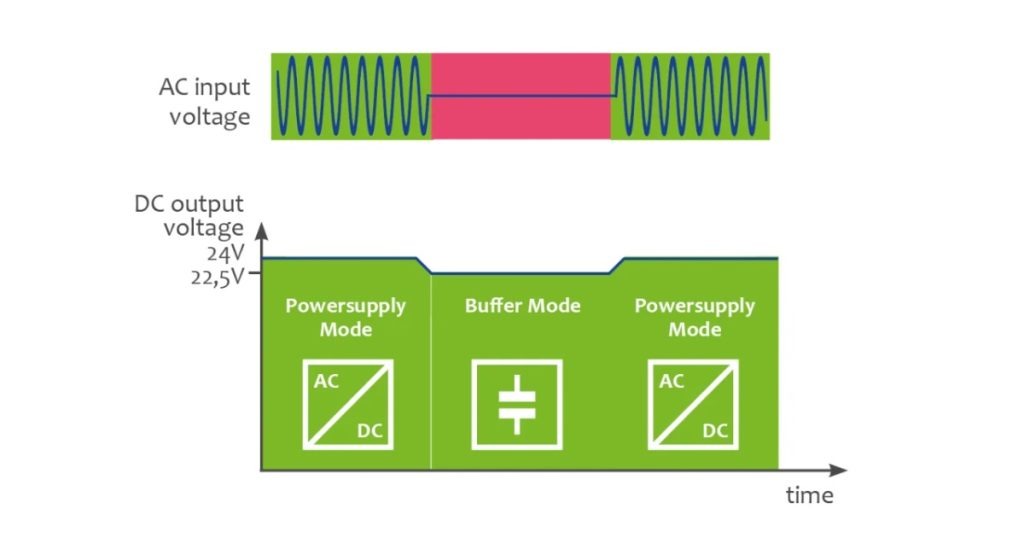
Visualizing the Bridging Phase
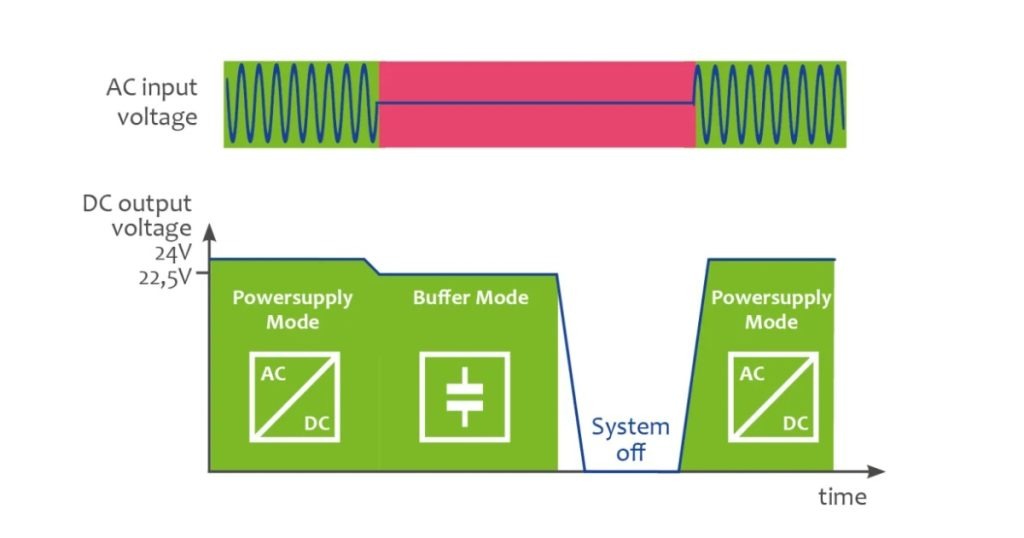
A typical power interruption scenario involves two voltage curves:
- The AC input voltage, which drops during an outage
- The DC output voltage, which remains stable due to the buffer module
As soon as the DC output from the power supply drops below 22.5 V, the buffer module automatically takes over, maintaining a stable voltage to the connected load. Once the AC mains returns, the power supply resumes operation seamlessly—ensuring uninterrupted power delivery to critical DC consumers.
Custom Buffer Voltage Configuration for Voltage-sensitive Applications
PULS offers a unique feature in its UF series buffer modules: the ability to configure the minimum buffer voltage to precisely 1 V below the set output voltage. For example, if the power supply is set to deliver 28 V, the buffer module can be parameterized to activate at 27 V—rather than the standard threshold of 22.5 V.
This fine-tuned voltage adjustment is particularly beneficial for voltage-sensitive loads or systems with tight tolerance requirements, where even minor voltage drops can cause instability or data loss. In standard operation, buffer modules only engage when the output voltage falls to 22.5 V. With this configurable feature, however, buffering begins earlier, ensuring a more stable and reliable DC power supply for critical components.
Controlled Shutdown with Capacitor-based Buffer Modules During Extended Power Interruptions
Capacitor-based buffer modules are ideal for applications that require a limited bridging time to safely shut down systems following a DC power outage. These modules provide a short but critical time window to transition equipment into a defined, de-energised state—minimising the risk of data loss or hardware damage.
Early detection of voltage drops is essential for this strategy. Typically, this is achieved via the DC-OK signal at the output of the power supply. Once a drop is detected, the buffer module immediately takes over the load supply and maintains stable DC voltage until its stored energy is depleted.
This controlled shutdown capability ensures a fault-free restart and protects sensitive components such as PLCs, industrial PCs, and automation controllers. It’s a key feature for maintaining operational integrity in industrial environments with unpredictable power conditions.
Note: If the actual load is below the maximum permissible output current of the buffer module, the available buffer time is extended accordingly. Therefore, a careful choice of the power supply considering the actual power consumption is crucial for the effectiveness of the shutdown strategy.
Capacitor Buffer Modules for Targeted Sub-branch Protection
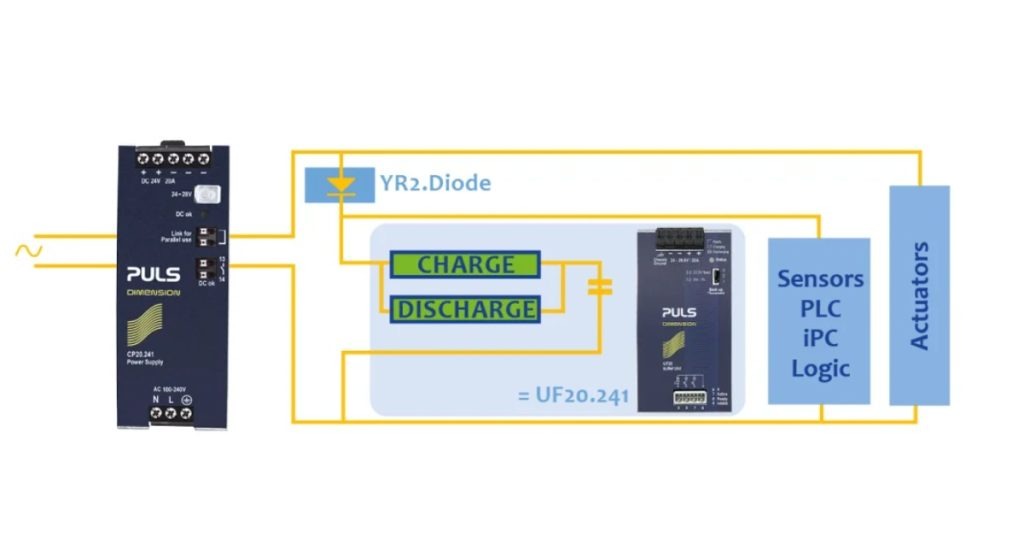
In industrial DC systems, capacitor-based buffer modules can be strategically deployed to protect sensitive sub-branches of the power supply. By integrating a redundancy module, the output side of the power supply is divided into buffered and unbuffered branches—optimising energy distribution based on load sensitivity.
Power-intensive consumers such as actuators are connected directly to the power supply and excluded from buffering. This ensures that the buffer energy is reserved for critical components like sensors, PLCs, industrial PCs, and control logic.
This targeted buffering approach significantly extends the available buffer time, often reaching into the seconds depending on system architecture. It enables reliable data retention, controlled shutdown sequences, and improved resilience for voltage-sensitive equipment.
Cascading Capacitor-based Buffer Modules: Extend Buffer Time & Boost Peak Current Capacity
Capacitor-based buffer modules from the PULS UF series are engineered for seamless integration in industrial DC systems. These modules, equipped with electrolytic capacitors, function like electronic capacitors and can be connected in parallel—either at the power supply output or directly at the load.
By cascading multiple buffer modules, users can:
- Extend buffer time during power interruptions
- Increase peak current capability without oversizing the power supply
- Optimize system design for dynamic load profiles
This modular approach offers several advantages:
- Cost savings through the use of smaller, more efficient power supplies
- Improved operational reliability during short-term load peaks
- Flexible scalability by expanding buffer capacity as needed
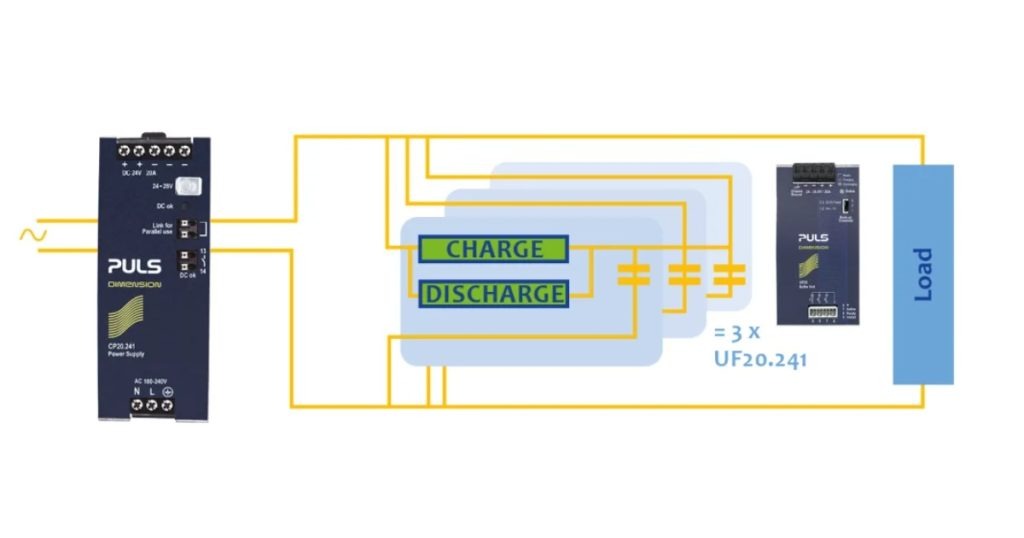 Parallel Connection of UF Series Buffer Modules to Extend Buffer Time or Increase Peak Current Reserves.
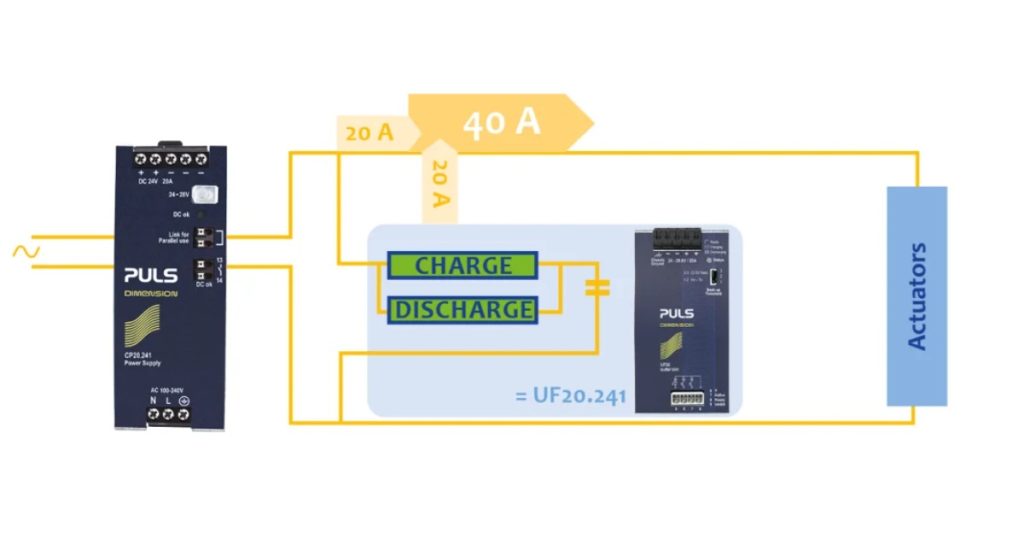 Coverage of Peak Currents Through Additional Energy From the Buffer Module.
During high inrush current events—such as motor or conveyor system restarts—the buffer module supplements the power supply with additional current. This prevents overload conditions and ensures stable operation.

Practical Example: Buffering in Intralogistics Systems
In conveyor systems used in intralogistics, goods are frequently stopped and restarted. These restarts generate brief but intense current spikes. By integrating a buffer module, engineers can select a smaller power supply optimized for continuous operation, while the buffer module handles the short-term peak loads.
Conclusion: Selecting the Right Buffer Strategy for Reliable DC Power Supply
This article focuses exclusively on capacitor-based buffer modules and their role in short-term DC power continuity. These modules offer fast response times, scalable energy storage, and targeted protection for sensitive components—making them ideal for bridging millisecond-level interruptions, managing dynamic load profiles, and enabling controlled shutdowns during extended outages.
For applications requiring longer bridging times – from several minutes to hours – DC-UPS systems with battery storage provide the necessary autonomy and flexibility. These systems are designed to maintain regulated output voltage, support critical infrastructure, and offer advanced features such as black start capability and intelligent battery management.
In the next article, it will explore DC-UPS solutions in detail, highlighting their technical advantages, configuration options, and use cases in environments where uninterrupted power is essential.
Which Back-up Solution Works Best for Your Application?
Speak directly with PULS experts – they can support you in the selection, design-in and integration of the appropriate buffer solution. Contact the team HERE
For more information on PULS solutions HERE


Capacitor-Based Capacitor-Based Capacitor-Based