Robots Aren’t Taking Over Manufacturing – They’re Making It Easier
April 6, 2020

By Adam Welch, Product Manager for Robotics, Mitsubishi Electric Automation

You might think of product being transported via conveyors, and people lined up at different stations. These people are probably doing repetitive tasks like placing components onto an assembly. Of course, if you work in automation or your facility has automation deeply integrated in its processes, you know that this sort of thing is not as common anymore. That’s not to say that manufacturing facilities no longer have manual processes, because human minds are needed for complex assembly, quality control inspection, and other tasks that require the sort of cognitive thinking that only humans are capable of. I have to say, the supposed “robot revolution” where automated processes take over completely, and humans are unneeded, is something of a fantasy. We are nowhere near that today, not even in the context of a manufacturing facility.

What is happening, however, is that some of the more mundane jobs that operators are tasked with are going away. I’m talking about the operator who does nothing but place parts onto assembly features or CNC machines for 8-10 hours a day.

It’s true that many of these jobs, which are often low pay, unfulfilling, unsafe, and require little to no intellectual capability, are now capable of being done by robots. Nevertheless, what I often find is that facilities are not letting go of these workers outright, but instead freeing them up to do less mundane tasks. That is happening right now. I want to dispel of the narrative that introducing a robot into your facility means that people will lose their jobs. It’s often untrue. Robots are freeing workers from routine tasks and allowing them to excel in areas that require creative skill and critical thinking.

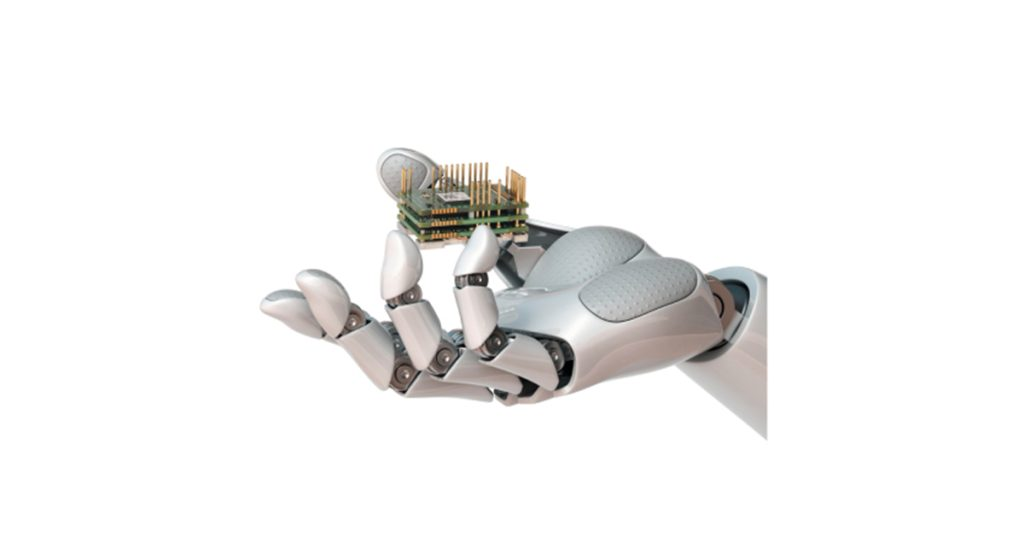
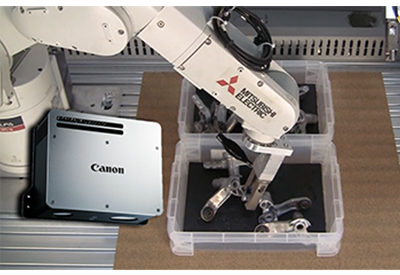
To facilitate this, robots are getting better and better at recognizing loose parts. That’s why Mitsubishi Electric is partnering with Canon on an innovative new 3D Vision solution. By using Canon’s 3D Vision technology, Mitsubishi Electric robots can recognize a singular part at any orientation by simply uploading a CAD file and taking a picture. The robots can now distinguish between multiple bin, recognizing one part per bin, and having a “memory” or library of 200 individual parts. The robot is now able to perform these repetitive tasks mistake-free, and allows facilities to cut down on expensive, space-hogging equipment such as feeder bowls.

3D Vision is a really cool innovation that gives our robots a strong artificial intelligence aspect, which I know can be intimidating to some people. And it is true the Canon 3D Vision solution allows a robot to essentially replace the mundane tasks of a human worker. But rest assured, this solution was designed to free operators to do tasks that require more cognitive thinking.

Source

Related Articles


Changing Scene

  • Weidmüller Canada Is Growing Their Team & Investing in the Future of Engineering

    Weidmüller Canada Is Growing Their Team & Investing in the Future of Engineering

    Weidmüller Canada is growing their team and investing in the future of engineering. They are proud to welcome Ada Santavy, Laura Cochrane, and William Watson, the newest hires of Weidmüller’s Engineering Launchpad Program, an innovative initiative that combines technical and soft skills training, mentorship from industry veterans, and hands-on project experience to develop well-rounded engineering… Read More…

  • Leviton Canada Announces Jim Hartery as New Territory Manager, Alberta

    Leviton Canada Announces Jim Hartery as New Territory Manager, Alberta

    Please join Leviton Canada in welcoming Jim Hartery to their team! Jim brings extensive experience in sales and account management within the electrical industry, along with a proven track record of building strong customer relationships, developing new business opportunities, and driving growth across both new and existing accounts. Leviton is thrilled to have Jim on… Read More…


Sponsored Content
The Easy Way to the Industrial IoT

The way to the Industrial IoT does not have to be complicated. Whether access to valuable data is required or new, data-driven services are to be generated, Weidmuller enables its customers to go from data to value the easy way. Weidmuller’s comprehensive and cutting-edge IIoT portfolio applies to greenfield and brownfield applications. Weidmuller offers components and solutions from data acquisition, data pre-processing, data communication and data analysis.

Visit Weidmuller’s Industrial IoT Portfolio.


ADVANCED Motion Controls Takes Servo Drives to New Heights (and Depths) with FlexPro Extended Environment Product Line

Advanced Motion Controls is proud to announce the addition of six new CANopen servo drives with Extended Environment capabilities to their FlexPro line. These new drives join AMC’s existing EtherCAT Extended Environment FlexPro drives, making the FlexPro line the go-to solution for motion control applications in harsh environments.

Many motion control applications take place in conditions that are less than ideal, such as extreme temperatures, high and low pressures, shocks and vibrations, and contamination. Electronics, including servo drives, can malfunction or sustain permanent damage in these conditions.

Read More


Service Wire Co. Announces New Titles for Key Executives

Bruce Kesler and Mark Gatewood have been given new titles and responsibilities for Service Wire Co.

Bruce Kesler has assumed the role of Senior Director – Business Development. Bruce will be responsible for Service Wire’s largest strategic accounts and our growing Strategic Accounts Team.

Mark Gatewood has been promoted to the role of Vice President – Sales & Marketing. In this role, Gatewood will lead the efforts of Service Wire Company’s entire sales and marketing organization in all market verticals.

Read More


Tri-Mach Announces the Purchase of an Additional 45,000 sq ft. Facility

Tri-Mach Elmira Facility

Recently, Tri-Mach Inc. was thrilled to announce the addition of a new 45,000 sq ft. facility. Located at 285 Union St., Elmira, ON, this facility expands Tri-Mach’s capabilities, allowing them to better serve the growing needs of their customers.

Positioning for growth, this additional facility will allow Tri-Mach to continue taking on large-scale projects, enhance product performance testing, and provide equipment storage for their customers. The building will also be the new home to their Skilled Trades Centre of Excellence.

Read More


JMP Parent Company, CONVERGIX Acquires AGR Automation, Expanding Global Reach

Convergix Automation Solutions has completed the acquisition of AGR Automation (“AGR”), a UK-based provider of custom, high-performance automation design and systems integration primarily to the life sciences industry.

Following Convergix’s acquisitions of JMP Solutions in August 2021 and Classic Design in February 2022, AGR marks the third investment in Crestview’s strategy to build Convergix into a diversified automation solutions provider targeting the global $500+ billion market, with a particular focus on the $70 billion global systems integration and connectivity segments. Financial terms of the transaction were not disclosed.

Read More


Latest Articles

  • Texcan: Teck, Vertical Riser & AIRGUARD – Cable Solutions for Demanding Environments

    Texcan: Teck, Vertical Riser & AIRGUARD – Cable Solutions for Demanding Environments

    Teck, Vertical Riser Teck, and AIRGUARD address distinct installation needs for industrial and vertical‑riser installations. Each product targets specific installation needs: Teck for general industrial feeders, Vertical Riser Teck for continuous vertical runs, and AIRGUARD to deliver high crush resistance and corrosion protection on long runs. Understanding the differences in application can help ensure the right cable is selected for the… Read More…

  • Mouser: Industrial Ethernet vs Fieldbus – Architecture, TSN & Migration

    Mouser: Industrial Ethernet vs Fieldbus – Architecture, TSN & Migration

    Fieldbuses once replaced bundles of wiring with shared, deterministic networks. For years, they carried control signals reliably and predictably. However, as equipment, sensors, and data systems proliferated, fieldbus limitations emerged. The central issue today is real-time operational visibility. Engineers need networks that move control data, diagnostics, and process information across the plant as reliably as… Read More…