Mouser: Mitigating Growing EMI Challenges from High-Efficiency Power Systems
March 26, 2026
EMI Challenges: How Effective Filtering Helps Companies Maximize Efficiency Gains
By: Peter Welander
As applications for variable speed motors and battery charging become more widespread, conducted EMI is also increasing, but there are solutions.
Around 2020, Tesla stopped putting AM radios in its vehicles. Tesla and other makers of electric vehicles (EVs) asserted that electrical noise from high-frequency switches and electronic equipment built on wide-bandgap semiconductors ruined reception. Conventional FM radios are less severely affected, but they are also being phased out.
Electromagnetic interference (EMI) can be an annoyance to radio listeners, but in industrial environments, EMI problems are increasing as today’s power systems scale up to improve efficiency. On this larger scale, the effects are more damaging than poor reception.
Today’s power systems are designed for efficiency. A common tactic is the use of variable-frequency drives for motors, allowing speeds to be optimized while minimizing power consumption. Such systems increasingly depend on silicon carbide (SiC) and gallium nitride (GaN) components rather than traditional silicon, due to their wide-bandgap characteristics, which permit better performance in high-voltage, high-temperature, and high-frequency applications. The result is lower power consumption and higher power density, which are important in challenging applications such as EVs.
Electronic equipment used in these applications must be tested for electromagnetic compatibility (EMC) in accordance with multiple standards and protocols. These testing methods also evaluate EMI characteristics. Passing EMC is typically required for market access and helps reduce the risk of interfering with nearby equipment and infrastructure.
This article discusses how high-efficiency power conversion using SiC and GaN devices is increasing conducted EMI in modern industrial and energy systems, and how proper front-end filtering helps mitigate those effects.
High Efficiency as Baseline
Designing electrical equipment involves balancing complex trade-offs, with market forces determining priority. Modern design cycles frequently prioritize early optimization for power level, efficiency, cost, and power density. This is understandable, but it deprioritizes EMI concerns. The highest practical switching speeds are applied for each type of transistor, SiC for its high power handling and GaN for its high speeds. Designers push these to their edge rates to deliver maximum performance, always trying to squeeze out more efficiency, thermal margin, and power density to reach platform-level performance targets. Some EMI-minimizing mechanisms are built in, but they stop short of impacting performance. When the desired characteristics are optimized, producers hope that the product will still pass EMC testing.
The basic architecture of a system and its resulting current paths determine how conducted EMI propagates. When currents flow through circuit imbalances or certain parasitic circuit elements, it creates conducted EMI. This type of interference can also be created by PC board trace inductances and capacitances. The resulting noise can couple to other areas of the circuit magnetically (inductive) or electrically (capacitive).
The following design choices can influence these effects:
- Power Stage Topology—The arrangement of switches, diodes, inductors, etc., for efficient power conversion.
- DC-Link & Input Network Structure—The intermediate stage that decouples the primary source from downstream power-conversion stages.
- Cable Length, Grounding Scheme & Enclosure Design—Good configuration choices minimize undesired output.
Once designers make these choices, correcting for their effects later via local tuning becomes very difficult. Careful choices early on are critical.
How EMI Results from High-Efficiency Designs
EMC testing labs (Figure 1) closely examine equipment. While they cannot determine the equipment’s efficiency during a test, they can draw conclusions from the configuration about how much EMI a given design is likely to generate.
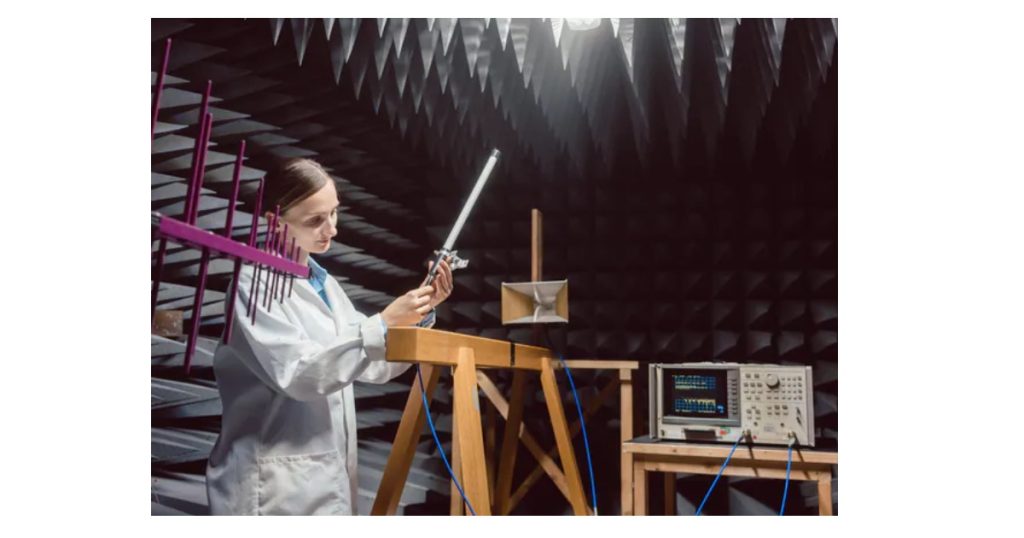 Figure 1: EMC testing labs quantify both conducted and radiated EMI from subject devices.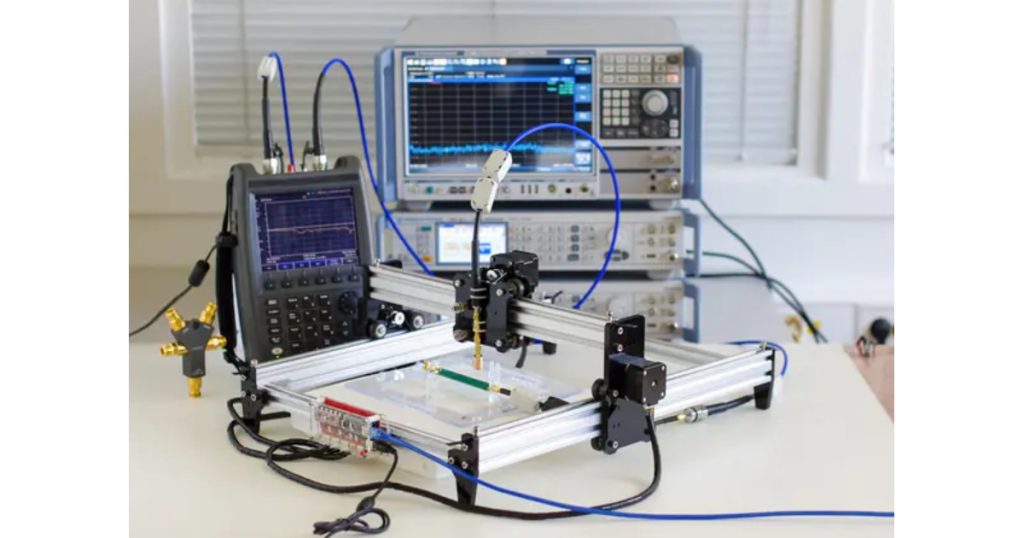
Designers often undermine their own efforts by raising switching frequencies to achieve higher efficiency. However, pushing frequencies to edge rates to reduce switching losses increases the noise’s spectral bandwidth. Unfortunately, some frequency ranges and their harmonics cause problems with other types of equipment, including various medical devices. EMC testers are mostly concerned with frequencies between 150kHz and 30MHz for conducted EMI, as these frequencies cause the greatest interference with specific classes of consumer, medical, and industrial equipment.
Parasitics also create EMI. Circuit designers understand the relationship between switching speed and EMI. But layout and packaging parasitics can create unexpected resonance and coupling paths that amplify both common-mode and differential-mode emissions. As switching speed increases, other elements of the physical system can further increase EMI levels. These parasitic sources take a variety of forms, including coupled traces/loops, position of individual components, power cable type and routing, and enclosure design.
These items and interactions act as inductive and capacitive elements when placed in high-frequency switching circuits. For example, the internal transformer in a DC-DC converter can couple to a nearby PCB trace, inducing a current at the converter’s frequency. These parasitics shape how switching noise couples to input lines, but the effect can be difficult to predict because so many elements come into play. Small differences in the positioning of individual components on the PCB can create or eliminate such coupling, as can cable positions. Interactions are difficult to predict, but guidelines exist for avoiding some recognized sources.
Challenges & Mitigation Approaches
The ability to utilize today’s variable-voltage and variable-frequency systems has delivered substantial energy savings across many applications. Such sophisticated power management is available in high-incidence areas such as variable-speed motor drives, HVAC and climate-control systems using heat pumps, and charging infrastructure for EVs.
These all have similar basic operational characteristics:
- Fast switching and high power levels to maximize efficiency
- Three-phase plus neutral power distribution
- Elevated common-mode EMI where current flows in one direction using a neutral or earth to complete the circuit (EMI is driven heavily by parasitics)
- Elevated differential-mode EMI where current flows in both directions (EMI is driven by line impedances)
When creating a new piece of equipment from scratch, it is possible to incorporate EMI mitigation strategies early on, although this may require multiple prototyping stages. But later in the process, one must find ways to reduce EMI from existing equipment or new installations. Where there is no opportunity to modify the equipment itself, the more practical solution is a system-wide approach with an appropriate filter on supply lines to isolate the equipment and protect other applications farther upstream. To mitigate conducted emissions from moving into the supply, such solutions call for system-level filtering capable of handling a neutral.
Prime examples of effective filtering architecture include the TE Connectivity/Schaffner FN3297 and FN3298 filter series. These filters, engineered for industrial automation and climate control systems, provide robust conducted EMI mitigation for three-phase plus neutral systems. Designed for 480VAC nominal operation, they support current ratings from 8A to 36A, have short-circuit current rating (SCCR) of 100kA, and comply with IEC and UL standards. The filters feature compact construction, front wiring, and withstand surge levels up to 4kV (L-PE) with high insulation resistance.
Conclusion
Efficiency gains from wide-bandgap-based equipment can be substantial, although conducted EMI effects often remain troublesome. However, once appropriate mitigation strategies have been adopted, they remain in place and do not normally create ongoing costs. Effective filtering, as offered by TE Connectivity/Schaffner products, provides practical, cost-effective solutions for systems, helping companies maximize efficiency gains.
For more information on Mouser Electronics solutions HERE

EMI Challenges EMI Challenges EMI Challenges EMI Challenges EMI Challenges EMI Challenges EMI Challenges EMI Challenges EMI Challenges EMI Challenges EMI Challenges EMI Challenges EMI Challenges EMI Challenges EMI Challenges EMI Challenges EMI Challenges EMI Challenges