Gapless Safety with Leuze

December 9, 2022

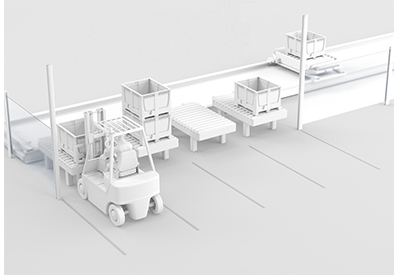
In applications where corridor supply vehicles interact at transfer stations with a direct connection to a danger zone, operation must be as safe and efficient as possible: Throughout the entire area, the safety system must be able to differentiate reliably between forklift trucks and, in some cases, also people. This is possible using a Leuze safety solution for multi-station access guarding in forklift truck logistics.

Person or vehicle?

Transfer stations are often directly connected to danger zones. At these stations, corridor supply vehicles such as forklift trucks carry materials in and out. These zones can be dangerous for people in the immediate vicinity due to adjacent machines or cross conveyors that feed the transfer stations. Both manufacturers and operating companies are therefore responsible for safeguarding the access points of the machines and transfer stations. The challenge is how to ensure maximum efficiency during operation while also protecting operators and other people.
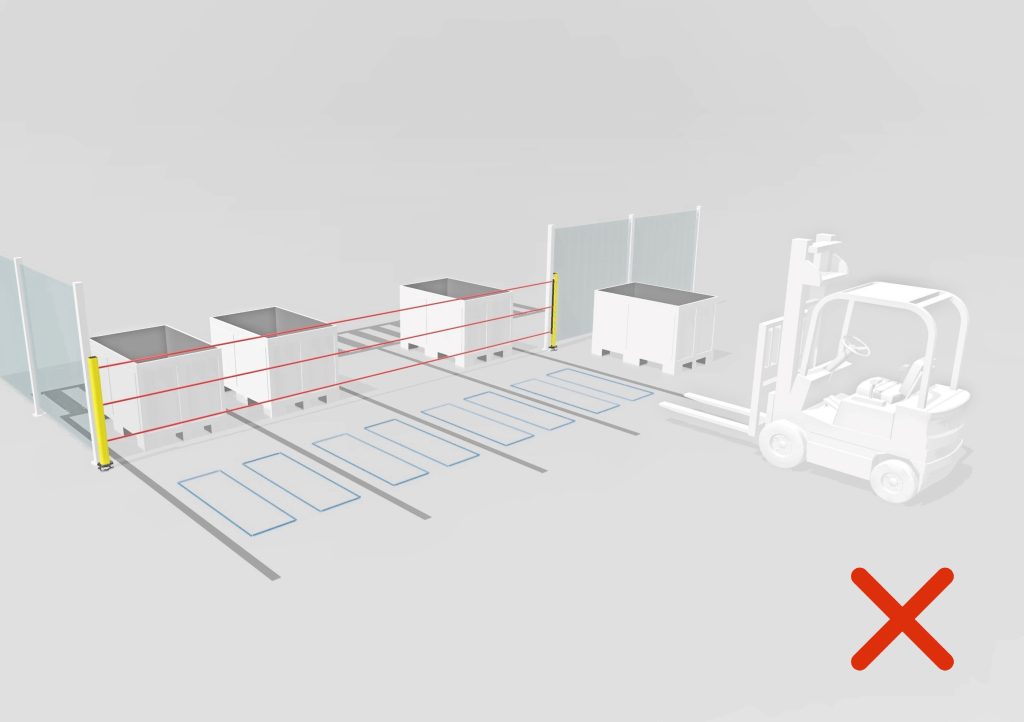
To fulfill these two aims, the safety concept must be able to reliably differentiate between forklift trucks and people. Two safety functions are particularly relevant here: Firstly, stopping the dangerous movement in good time. Secondly, releasing access to the danger zone only to specified forklift trucks. Various concepts are possible and in use to prevent people from accessing such transfer stations and permit only forklift trucks to enter. However, the safety-related evaluation of these concepts often shows significant differences regarding the residual risks. Such risks can even be so great that a concept proves insufficient.

Conventional muting with a high residual risk

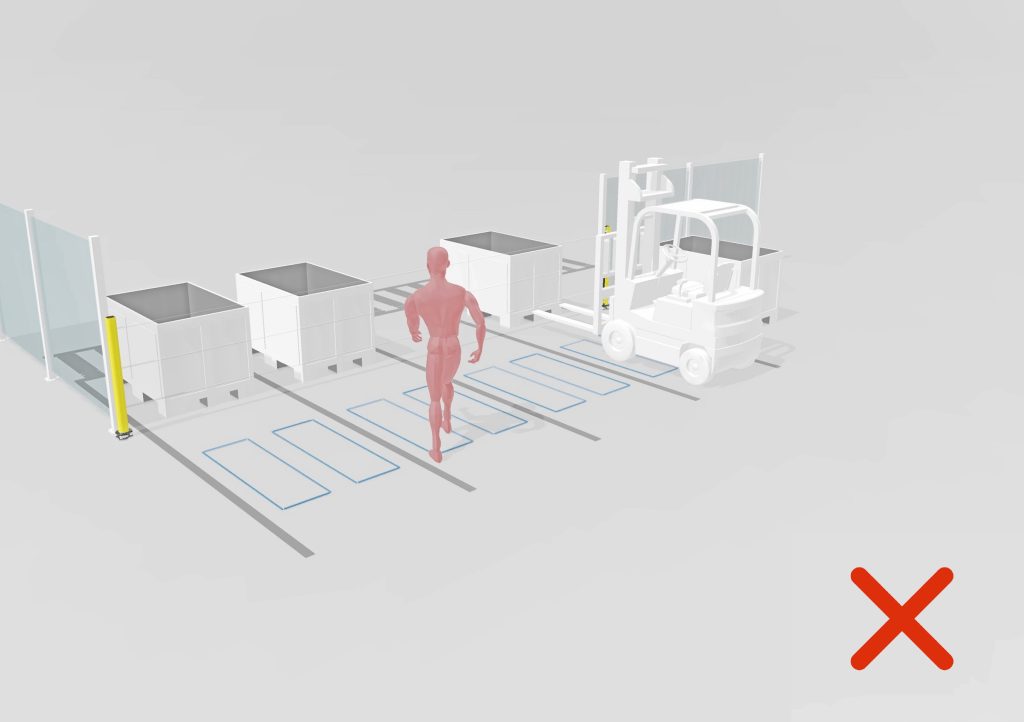
An obvious approach uses a type of “muting” with induction loops as a trigger signal. The induction loops, which are embedded in the floor before every transfer station as “muting sensors”, make it possible, in principle, to differentiate between high-lift trucks and people. However, to differentiate SAFELY, additional evaluation measures are generally required. Nevertheless, the main deal breaker for this approach is ultimately the muting requirements specified by standards such as IEC 62046, which are not met. This is because, if all transfer stations are safeguarded jointly by an active opto-electronic protective device (AOPD) used for muting, the presence of a forklift truck on one loop pair triggers the muting function for the entire area – i.e. across all stations.

At that moment, people can enter the danger zone along with the forklift truck, undetected and without realizing. While the high-lift truck stands on the induction loop, the muting function is active and the safety function of the AOPD is overridden. At the same time, the lateral distances between the muting object (here, the forklift truck) and the fixed limit are far too great and therefore no longer compliant. As a result, a conventional muting approach is not suitable for this type of application. In addition to the large amount of effort required to install the induction loops, the approach has residual risks and does not comply with the muting requirements of standards.
Better suited intelligent safety concepts

A better approach for multi-station access guarding in forklift truck logistics is based on sequence- and time monitored protective field adjustment that fits the zone precisely. In these respects, this approach differs greatly from the above-mentioned muting concept, which is primarily timing controlled and covers the whole area. The principle: Safety laser scanners with vertical protective fields safeguard the access area for all transfer stations. At each station, additional sensors monitor the entrance of forklift trucks and supply this information to the safety system. These sensors detect when a forklift truck drives into the transfer station from in front. Only in this case does the safety concept release a defined area in the protective field precisely for this one station.

During this process, all other stations remain safeguarded by their own protective fields, which are still active. Once the forklift truck has left the transfer area, the protective field is reset to its original state and the whole area is once again safeguarded. As part of this approach, the functionality of a Leuze safety laser scanner allows it to safeguard multiple transfer stations simultaneously.

Interruption-free operation

Another advantage of this solution is that this safety concept enables goods to be handled at transfer stations that are intended for this purpose and located behind an opto-electronic protective field, without interrupting the work processes of adjacent machines. All stations can be used simultaneously and independently of each other. With this safety concept, the traffic area and the transfer area are safely separated from each other – this enables optimum workflows.

Above all, this safety concept differentiates reliably between forklift trucks and operators. The access-guarding protective fields must be positioned in such a way that the necessary safety distance from the danger zone is complied with. The time required to stop the dangerous movement must be taken into account. The requirements according to EN ISO 13855 and EN ISO 13857 apply here. To ensure that the system detects the forklift trucks reliably, system operators should use high-lift trucks that are similar in size and shape. In addition, there is a minimum speed at which vehicles must enter the transfer station to be detected as vehicles.

An optimal combination: Laser, ultrasound and radar
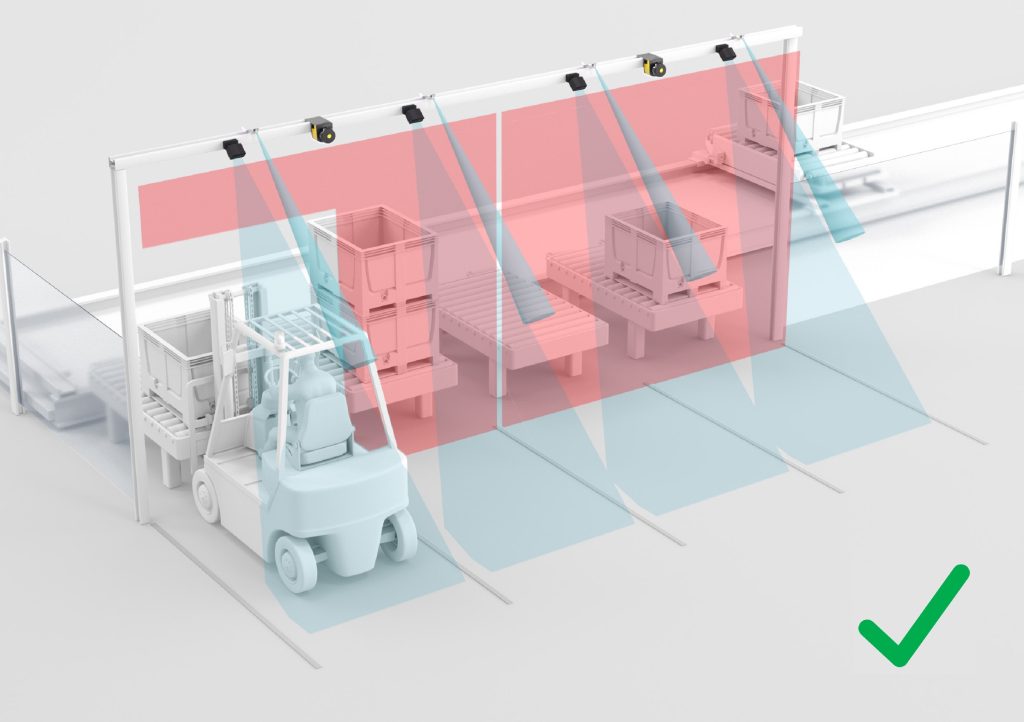
The Sensor People from Leuze offer this concept as a safety solution in a complete package. A core component is the RSL 400 safety laser scanners. They are installed vertically above the transfer stations so that they can safeguard the entire access area. A practical feature of the RSL 400 is that it can safeguard multiple transfer stations simultaneously due to its operating range of up to 8.25 meters and the parallel operation of various protective fields. This reduces the installation effort and helps to create a cost-optimized system design.

The Leuze project teams flexibly adjust the protective field configurations that are appropriate for the respective system to the conditions on site. The safety laser scanners are characterized by their robust operation. They filter out objects such as dust and particles due to their high angular resolution of 0.1 degrees – this makes the sampling rate 3x higher than that of conventional scanners. Other components of the safety solution include ultrasonic and radar sensors that are used for each station. A Siemens safety control, together with the associated Leuze safety program, is used to control the overall system.

Danger averted

For system operators, this approach to multi-station access guarding pays off: It is suitable for retrofitting existing systems as well as for new systems. The solution reliably differentiates between forklift trucks and operators, and operation is not interrupted. Even protection against bypassing is optimized and tampering prevented. The safety concept meets the requirements for performance level d according to EN ISO 13849-1 and therefore contributes significantly to reducing the risks at transfer stations. The safety integrity level according to EN IEC 62061 is SIL 2.

In addition, the solution can easily be scaled to the number of stations at any time – this offers flexibility for later extensions. The Leuze safety experts are happy to advise anyone interested in this concept at any time. They provide support relating to the safety solution from the target/actual analysis to the hardware selection including accessories, to the configuration, start-up support and validation of the application.

For more information, visit Leuze HERE.
Related Articles

  • Rockwell Automation Introduces The Connected Mine


    Like many cyclical industries, mining is reviving, driven by steady global economic growth and an increasing demand for materials to support new technologies like electric vehicles, renewable energy and mobile devices. Despite the optimism, the industry still faces major operational challenges including process efficiencies, cost control, worker health and safety, and skills gaps.


  • | |

    ABB Invests in Made in Canada with Installation Products that Electrify Our World 

    ABB recently announced their plan to build a new R&D and manufacturing facility in Canada. It will combine their existing facilities in Iberville and Saint-Jean-sur-Richelieu to increase production capacity and support future growth in key sectors across Canada like utilities, energy, and infrastructure. Michael Shenouda, Canada Region Leader – General Manager, Installation Products, answers my questions about the new facility. Shenouda started at ABB for a summer job, now, 30 years later, he plays a leading role in the company. “Made in Canada” is something that ABB strives for. It is something they promote. And they have been doing this for decades. “It is something we are proud of,” Shenouda says. “I think the pandemic has proved that having robust supply chains close to where customers’ needs are is very important. We source all our steel locally; within 500 kilometers of the factories we operate. Our aluminum is mostly Canadian as well. We are very proud to have 600 employees in both our Iberville and Saint-Jean facilities.”  

  • |

    SmartD: VFD Leakage Current & Ground Fault Protection – Ensuring Safety & Compliance

    Imagine a bustling manufacturing plant where machines produce thousands of components every hour. The electrical cabinets buzz with energy, and a labyrinth of cables branches out to every corner, connecting motors large and small. In one corner stands a shiny new Variable Frequency Drive (VFD) controlling a high-horsepower motor. Nearby, an experienced technician named Alex notices something on his handheld meter: a small current is flowing to the ground. At first, it might seem like no big deal, just a few milliamps. But is it dangerous? Or completely normal? This is the heart of the story, and it brings up a question that might be obvious to an experienced professional but still makes you think deeply: Why do we place so much emphasis on the small currents? Why do engineers and technicians, meticulously measure, analyze, and sometimes worry about these tiny currents that appear to do no harm? The reason, of course, is because these small currents can be indicators—indicators of normal operation, or signs of a potential problem that could cause serious safety issues. Welcome to the world of leakage current and ground faults in VFD systems. This article will explore these phenomena with a didactic approach, focusing on why they matter, how they behave, and what sets them apart, especially when looking at clean power VFDs. Whether you’ve spent decades in electrical systems or you’re just stepping into this specialized area, this exploration aims to reinforce the concepts and inspire you to dig deeper into the nuances of these tiny but critically important currents.

  • How IO-Link Improves Predictive Maintenance and Speeds Up Sensor Reconfiguration

    One of Omron’s main focuses with respect to sensor innovation is to incorporate more “intelligence” – that is to say, more ways to gather meaningful data – into their latest sensor lines. Smarter sensors mean better insights into what’s really going on at the machine level, and these insights lead to better decision-making and less downtime.


  • |

    HELUKABEL: Demonstrating HELUCHAIN MULTISPEED Offerings at Hannover Messe

    At Hannover Messe 2025, the HELUKABEL Group is presenting electrical connection technology from a single source. From March 31st to April 4th, they are exhibiting their continuously growing portfolio of reliable power and data transmission solutions – for the first time in hall 9 at stand H55. HELUKABEL’s portfolio includes cables and wires, high-quality drag chains and drag chain systems, and complete, pre-assembled, and installation-ready system modules.

    At their stand, they will be presenting various products including drag chain cables from the HELUCHAIN MULTISPEED series, which are specifically designed for the high mechanical loads of drag chains. In order to cover the largest spectrum of applications, HELUKABEL offers MULTISPEED cables as a modular system in a number of diameters and with different plastic qualities including robust and abrasion-resistant TPE, bend-resistant PUR, and cost-effective and versatile PVC. With this selection, customers can find the optimal cable for every application and for every budget. The HELUCHAIN MULTISPEED series includes control and connection cables, single-conductor cables, as well as data cables.


Changing Scene


Sponsored Content
The Easy Way to the Industrial IoT

The way to the Industrial IoT does not have to be complicated. Whether access to valuable data is required or new, data-driven services are to be generated, Weidmuller enables its customers to go from data to value the easy way. Weidmuller’s comprehensive and cutting-edge IIoT portfolio applies to greenfield and brownfield applications. Weidmuller offers components and solutions from data acquisition, data pre-processing, data communication and data analysis.

Visit Weidmuller’s Industrial IoT Portfolio.


ADVANCED Motion Controls Takes Servo Drives to New Heights (and Depths) with FlexPro Extended Environment Product Line

Advanced Motion Controls is proud to announce the addition of six new CANopen servo drives with Extended Environment capabilities to their FlexPro line. These new drives join AMC’s existing EtherCAT Extended Environment FlexPro drives, making the FlexPro line the go-to solution for motion control applications in harsh environments.

Many motion control applications take place in conditions that are less than ideal, such as extreme temperatures, high and low pressures, shocks and vibrations, and contamination. Electronics, including servo drives, can malfunction or sustain permanent damage in these conditions.

Read More


Service Wire Co. Announces New Titles for Key Executives

Bruce Kesler and Mark Gatewood have been given new titles and responsibilities for Service Wire Co.

Bruce Kesler has assumed the role of Senior Director – Business Development. Bruce will be responsible for Service Wire’s largest strategic accounts and our growing Strategic Accounts Team.

Mark Gatewood has been promoted to the role of Vice President – Sales & Marketing. In this role, Gatewood will lead the efforts of Service Wire Company’s entire sales and marketing organization in all market verticals.

Read More


Tri-Mach Announces the Purchase of an Additional 45,000 sq ft. Facility

Tri-Mach Elmira Facility

Recently, Tri-Mach Inc. was thrilled to announce the addition of a new 45,000 sq ft. facility. Located at 285 Union St., Elmira, ON, this facility expands Tri-Mach’s capabilities, allowing them to better serve the growing needs of their customers.

Positioning for growth, this additional facility will allow Tri-Mach to continue taking on large-scale projects, enhance product performance testing, and provide equipment storage for their customers. The building will also be the new home to their Skilled Trades Centre of Excellence.

Read More


JMP Parent Company, CONVERGIX Acquires AGR Automation, Expanding Global Reach

Convergix Automation Solutions has completed the acquisition of AGR Automation (“AGR”), a UK-based provider of custom, high-performance automation design and systems integration primarily to the life sciences industry.

Following Convergix’s acquisitions of JMP Solutions in August 2021 and Classic Design in February 2022, AGR marks the third investment in Crestview’s strategy to build Convergix into a diversified automation solutions provider targeting the global $500+ billion market, with a particular focus on the $70 billion global systems integration and connectivity segments. Financial terms of the transaction were not disclosed.

Read More


Latest Articles

  • Mouser: New Tech Tuesdays – Multi-Port IoT Antennas Simplify Rugged Connected Designs

    Mouser: New Tech Tuesdays – Multi-Port IoT Antennas Simplify Rugged Connected Designs

    Connected edge devices increasingly need to do two jobs at once: maintain reliable wide-area communications and provide accurate location awareness. That combination shows up across smart terminals, kiosks, charging systems, mobile platforms, and remote monitoring equipment. In these designs, engineers must support modern cellular Internet of Things (IoT) protocols while also enabling Global Navigation Satellite… Read More…

  • Hammond: Why Are More Organizations Standardizing on Wall-Mount Server Cabinets?

    Hammond: Why Are More Organizations Standardizing on Wall-Mount Server Cabinets?

    For decades, the traditional server room was the center of an organization’s IT infrastructure. Servers, networking equipment, and telecommunications hardware were all housed in large floor-standing cabinets within dedicated spaces. Today, that model is changing. As networks become more distributed and organizations deploy equipment closer to users, applications, and connected devices, wall-mount server cabinets are… Read More…