What Are the Advantages & Disadvantages Between a Mechanical Flow Meter and a Magnetic Flow Meter?
What Are the Advantages & Disadvantages Between a Mechanical Flow Meter and a Magnetic Flow Meter

June 17, 2025

Mechanical & Magnetic Flow Meters: Pros & Cons

By: John Roushey, Product Manager for Magnetic & Ultrasonic Flow, Siemens

Recently, there has been a lot of discussion on using mechanical meters versus magnetic meters for the measurement of conductive liquid. While both flow meters offer benefits, is one more efficient and effective for you to use? The purchasing price is certainly a consideration, but it’s not the only thing that you should consider when looking at upgrading your system.


What Are the Differences Between the Two Flow Meters?

The primary difference between a mechanical meter and a magnetic meter is that a mechanical meter has moving parts and a mag meter doesn’t. Typical examples of mechanical meters are target meters, where liquid hits a spring-loaded plate and the amount of movement of that plate relates to velocity, and turbine meters, where liquid flowing over a set of angled blades causes those blades to rotate and that velocity is used to determine flow rate.

Another example would be a positive displacement (PD) or oval gear meter where a set amount of material moves through chambers and the amount of material that moves through these chambers as they rotate is counted and converted to flow rates. There are other mechanical designs, but you get the picture.

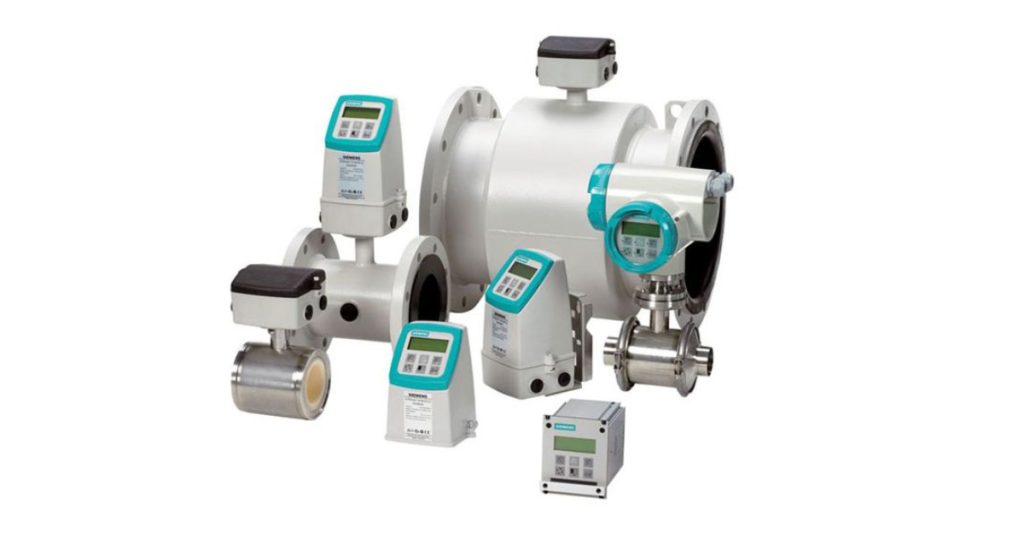
A mag meter works by having a conductive liquid flow through a lined flow tube and of the flow passing through a magnetic field generated as part of the flow tube design causes a voltage to be created. This voltage increases or decreases based on velocity. So, as long as the material meets the minimum conductivity level, there are no moving parts (mechanical motion) in the flow meter itself required to measure the flow rate through the meter.
What-Are-the-Advantages-Disadvantages-Between-a-Mechanical-Flow-Meter-and-a-Magnetic-Flow-Meter

Okay, Now That the Basic Concept of Each Flow Meter Has Been Explained, What Are the Advantages & Disadvantages?

Let’s start with the most basic aspect of a mechanical flow meter, and the fact that it is mechanical.

Disadvantage

One of the biggest disadvantages is that mechanical parts wear. As these parts wear, there are a variety of effects that the wear can have on your process. When parts wear, they do not work as well as they did when they were first designed or installed. Look at a pair of scissors, or a knife. When they were new, they cut easily and efficiently but as they are used, even if they are used properly, they lose their factory fresh sharpness and their ability to cut as effectively.

Solution

The solution is to sharpen them (maintenance) to reinstate their original performance and eventually you will need to get a new cutting tool (replacement). The same analogy can be used in mechanical flow meters.

Let’s look at the three mechanical examples provided at the beginning of this article.

A target meter is spring-loaded and needs a certain level of resistance in order to work to the design specifications. As the spring compresses and releases over time, the tension changes and, so does the accuracy. The target itself also has a specific surface area that is necessary for best performance and when the edges wear down, that surface area changes and so does the performance.

A turbine meter has blades that are specifically configured to rotate at a given speed for a given flow velocity. As the blades wear, that geometry changes and so does performance. Also, the ability of the blades to spin is related to the friction, or lack thereof, of the bearings that are part of the blade assembly. When the bearings wear, they require more energy to turn at the same rate. Again, this involves maintenance and eventual replacement.

In the last example, PD or oval gear meters were discussed. These are heavily geared meters with a lot of moving parts that work in mesh with each other to move material through them. The gears and bearings that move these gears are prone to wear and again, need maintenance and eventual replacement.

Magnetic flow meters, on the other hand, do not require as much maintenance as mechanical meters do. Now, that’s not to say that they never need maintenance or never need to be replaced. Any flow measurement device should be checked from time to time to make sure it is working properly and providing accurate flow measurement. What is meant is that without the mechanical issues associated with moving part flow meter designs, mag meters can have more extended maintenance cycles and an overall longer lifespan at the expected accuracy, without the need for replacement.

This is the first of a two-part blog series on mechanical flow meters versus magnetic flow meters. In part two, discussion will focus on issues such as mounting, straight run pipes, accuracy and the types of process that can be run through mag meters versus mechanical meter designs. So, stay tuned!

Source

What Are the Advantages & Disadvantages Between a Mechanical Flow Meter and a Magnetic Flow Meter

Related Articles


Changing Scene

  • Laurentide Controls Chooses Bécancour for Its 6th Centre

    Laurentide Controls Chooses Bécancour for Its 6th Centre

    With more than 50 years of industrial optimization experience in Eastern Canada, Laurentide Controls is officially opening its 6th centre, located in Bécancour. The objective is clear: bring expertise closer to industrial plants, speed up interventions, and generate measurable gains in reliability, productivity and energy performance – all directly benefiting businesses in the region and,… Read More…


Sponsored Content
The Easy Way to the Industrial IoT

The way to the Industrial IoT does not have to be complicated. Whether access to valuable data is required or new, data-driven services are to be generated, Weidmuller enables its customers to go from data to value the easy way. Weidmuller’s comprehensive and cutting-edge IIoT portfolio applies to greenfield and brownfield applications. Weidmuller offers components and solutions from data acquisition, data pre-processing, data communication and data analysis.

Visit Weidmuller’s Industrial IoT Portfolio.


ADVANCED Motion Controls Takes Servo Drives to New Heights (and Depths) with FlexPro Extended Environment Product Line

Advanced Motion Controls is proud to announce the addition of six new CANopen servo drives with Extended Environment capabilities to their FlexPro line. These new drives join AMC’s existing EtherCAT Extended Environment FlexPro drives, making the FlexPro line the go-to solution for motion control applications in harsh environments.

Many motion control applications take place in conditions that are less than ideal, such as extreme temperatures, high and low pressures, shocks and vibrations, and contamination. Electronics, including servo drives, can malfunction or sustain permanent damage in these conditions.

Read More


Service Wire Co. Announces New Titles for Key Executives

Bruce Kesler and Mark Gatewood have been given new titles and responsibilities for Service Wire Co.

Bruce Kesler has assumed the role of Senior Director – Business Development. Bruce will be responsible for Service Wire’s largest strategic accounts and our growing Strategic Accounts Team.

Mark Gatewood has been promoted to the role of Vice President – Sales & Marketing. In this role, Gatewood will lead the efforts of Service Wire Company’s entire sales and marketing organization in all market verticals.

Read More


Tri-Mach Announces the Purchase of an Additional 45,000 sq ft. Facility

Tri-Mach Elmira Facility

Recently, Tri-Mach Inc. was thrilled to announce the addition of a new 45,000 sq ft. facility. Located at 285 Union St., Elmira, ON, this facility expands Tri-Mach’s capabilities, allowing them to better serve the growing needs of their customers.

Positioning for growth, this additional facility will allow Tri-Mach to continue taking on large-scale projects, enhance product performance testing, and provide equipment storage for their customers. The building will also be the new home to their Skilled Trades Centre of Excellence.

Read More


JMP Parent Company, CONVERGIX Acquires AGR Automation, Expanding Global Reach

Convergix Automation Solutions has completed the acquisition of AGR Automation (“AGR”), a UK-based provider of custom, high-performance automation design and systems integration primarily to the life sciences industry.

Following Convergix’s acquisitions of JMP Solutions in August 2021 and Classic Design in February 2022, AGR marks the third investment in Crestview’s strategy to build Convergix into a diversified automation solutions provider targeting the global $500+ billion market, with a particular focus on the $70 billion global systems integration and connectivity segments. Financial terms of the transaction were not disclosed.

Read More


Latest Articles

  • Convergix: 4 Ways Factory Automation Improves Supply Chain Management

    Convergix: 4 Ways Factory Automation Improves Supply Chain Management

    Although the disruptions caused by the Covid-19 pandemic revealed the fragility of global supply chains, factory automation has stepped up to mitigate many of those shortcomings. Since the onset of the Covid-19 pandemic, manufacturers worldwide have become acutely aware of the interconnectivity of supply chains. More recent issues such as international trade disputes and labor… Read More…

  • Panduit: A Brief Evolution of Field-Terminated Fiber Connectors

    Panduit: A Brief Evolution of Field-Terminated Fiber Connectors

    Field termination of fiber optic cable connectors is nothing new, and while there have been various products to address field termination needs over the decades, the products discussed here are: field polish, mechanical splice, and fusion splice. Each of these has had time in the spotlight, and there are commonalities that hold true across all three. Chief… Read More…