A New Era: Towards Industry 5.0 & 6G

October 21, 2025
Industry 5.0 & 6G: Designed to Enable Immersive, Multi-Sensory Interactions Between Humans & Intelligent Systems
By: Caglar Firat, Developer/Engineer
Throughout history, there have been several industrial revolutions in manufacturing systems driven by technological advancements. The first revolution began with the use of mechanical power derived from water, steam, and fossil fuels. The second was characterized by the adoption of electrical machinery and assembly lines, which enabled mass production. Automation became the central goal of the third industrial revolution, and with the advancement of information technologies, Industry 4.0 emerged.
Cyber-physical systems were designed by integrating technologies such as the Internet, the Internet of Things (IoT), and cloud computing. Although Industry 4.0 has not been fully implemented worldwide, the concept of Industry 5.0 has emerged, emphasizing autonomous manufacturing that incorporates human intelligence both in and on the loop.
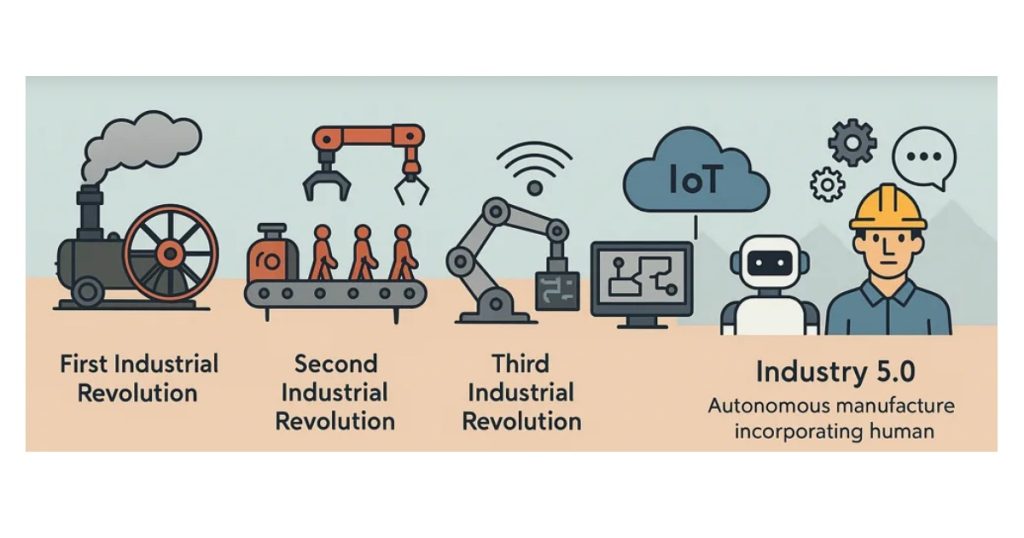
Industry 4.0 has faced several challenges and forms of resistance due to its design philosophy. One of the main criticisms is that human effort is treated merely as a cost to be optimized. In contrast, Industry 5.0 introduces a new perspective in which human intelligence and creativity are once again placed at the center of production, working in collaboration with intelligent machine systems. This perspective requires seamless harmony between humans and machines. Intelligent systems must be able to understand human intentions and their needs then respond to them in real time.
Complementing this vision, it is also important for humans to comprehend the reasoning processes of machine intelligence. Achieving this vision demands the use of advanced technologies such as extensive sensor networks and interoperable data infrastructures, autonomous intelligent systems, digital twins, explainable AI (xAI), and, consequently, 6G connectivity.
6G
According to the International Telecommunication Union (ITU), 6G is expected to be deployed around 2030. It is currently in the early development stages and will incorporate remote sensing and artificial intelligence (AI) alongside enhanced connectivity. To understand what 6G represents for the telecommunications sector, it is essential to examine the current status and evolution of 5G. 6G will enhance existing 5G capabilities, unlocking a wide range of innovative use cases that integrate AI, sensing, and communication.
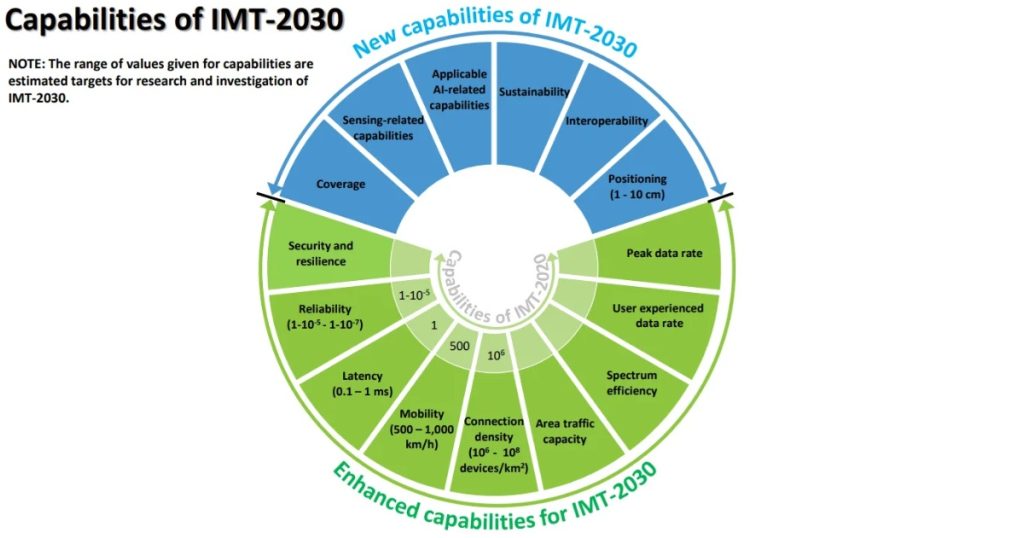
According to the ITU IMT-2030 framework, 6G will introduce nine enhanced capabilities derived from 5G and six entirely new ones. Meanwhile, 5G-Advanced, defined in 3GPP Release 18, introduces new use cases for AI and machine learning (AI/ML), whereas 6G is envisioned as an AI-native technology—meaning that AI functionalities are embedded into its architecture by design.
6G Usage Scenarios
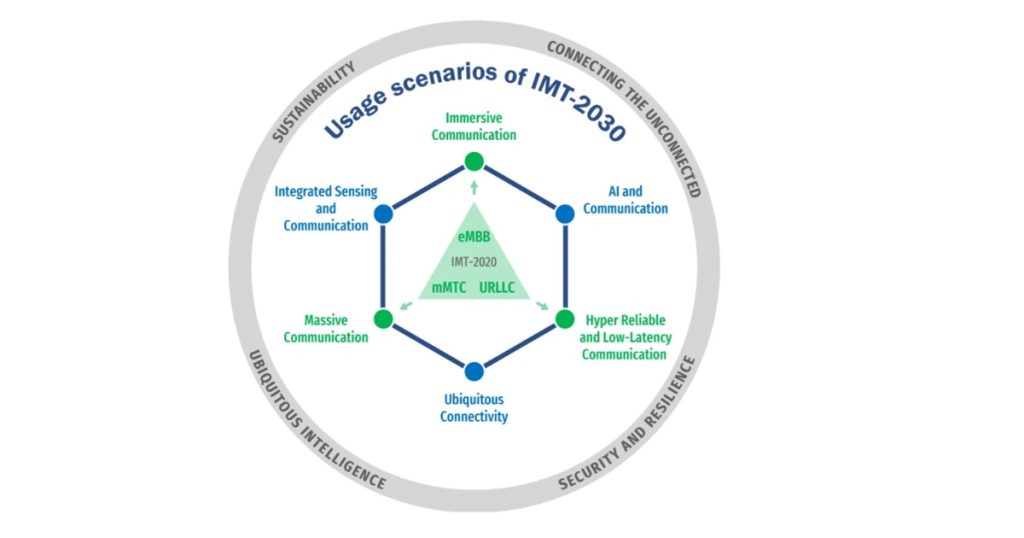
6G will extend current enhanced Mobile Broadband (eMBB), massive Machine Type Communication (mMTC) and Ultra-Reliable and Low-Latency Communication (URLLC) scenarios to Immersive Communication, Massive Communication and Hyper Reliable and Low-Latency Communication scenarios, respectively and brings three new ones that AI and Communication, Integrated Sensing and Communication, and Ubiquitous Connectivity.
Immersive Communication
Immersive Communication encompasses extended reality (XR), remote multi-sensory telepresence, and holographic communication, along with the real-time transmission of mixed media traffic—including video, audio, and environmental data—in a time-synchronized manner. This scenario requires high reliability and ultra-low latency, rather than being evaluated solely based on data rate performance.
Hyper Reliable & Low-Latency Communication
Hyper-Reliable and Low-Latency Communication (HRLLC) further extends the stringent requirements of URLLC in terms of reliability and latency. This scenario is particularly suitable for industrial environments, enabling full automation, real-time control, and mission-critical operations. It also requires precise positioning, high connection density, and deterministic communication, depending on the specific use case.
Massive Communication
Massive Communication extends the mMTC capabilities of IMT-2020 by supporting an enormous number of devices and sensors simultaneously. This enables large-scale applications such as smart cities, intelligent transportation systems, logistics networks, and other domains requiring massive Internet of Things (IoT) connectivity.
AI & Communication
The AI and Communication scenario supports distributed and collaborative AI applications, such as autonomous driving, inter-device collaboration, and digital twin creation and prediction. It enables the integration of AI computation and communication networks, allowing real-time learning, adaptation, and decision-making at the network edge [5].
Integrated Sensing & Communication
Integrated Sensing and Communication (ISAC) enables networks to sense the environment and analyze the behavior of connected and unconnected entities. This includes functions such as activity recognition, movement and gesture tracking, and situation or anomaly detection. By merging sensing and communication, 6G will support a wide range of context-aware and environment-interactive applications.
Ubiquitous Connectivity
Ubiquitous Connectivity reflects the vision of 6G as a bridge across diverse digital communication systems, ensuring that unconnected and under-connected regions gain access to high-quality communication services. It aims to overcome challenges of coverage, capacity, data rate, and mobility, providing seamless connectivity even in rural, remote, or sparsely populated areas. Moreover, it strives to maintain a consistent user experience across different environments, including deep indoor and high-mobility scenarios.
Conclusion
The transition to Industry 5.0 represents a profound and necessary evolution—one that steers global industry toward a paradigm that is sustainable, resilient, and human-centric. This shift is not a rejection of the technologies introduced in Industry 4.0, but rather a redefinition of their purpose: to augment human potential and advance societal well-being alongside economic growth.
At the heart of this transformation lies 6G, the technological fabric capable of weaving this vision into reality. Its architecture is being purposefully designed to deliver dependable, high-bandwidth, and ultra-low-latency communication—enabling immersive, multi-sensory interactions between humans and intelligent systems. 6G will form the backbone of trustworthy AI, distributed intelligence, and advanced human–machine collaboration that underpin the Industry 5.0 ecosystem.

Industry 5.0 Industry 5.0 Industry 5.0 Industry 5.0 Industry 5.0 Industry 5.0