IIoT, Connectors and Three Watchwords for the Factory of the Future
PB 26 Allied logo 400

August 4, 2020

Productivity, efficiency and quality are the three watchwords for the new dawn of the industrial internet of things (IIoT).  Under the surface of the well-wired floor of the factory of the future are connected devices, configured to make IIoT a reality.

Hank Graham, product manager for single board computers (SBC) and electronics at Allied Electronics and Automation, sees the factory of the future as an industrial site digging its heels firmly into automation.

Automation offers countless benefits, including the scalability, security and flexibility that today’s production environments require. Graham believes there’s opportunity to help production managers meet an ever-growing set of objectives with a production line featuring a well-designed automation network  and reliable components. These include mandates like increasing efficiency,  ensuring availability, preventing downtime and enabling interoperability.

Interoperability allows machines to securely communicate with each other, while harnessing certain attributes of artificial intelligence. This includes gathering data from manufacturing processes and using “deep learning” to fine-tune production like never before. Graham adds that interoperability also means having the capability to communicate and integrate with robotic systems and automated guided vehicles. Automated and interoperable, IIoT is geared to boost productivity, efficiency and quality.

Productivity 

The factory of the future is being shaped today. It is being built with connected devices and data within the service environments (which can sometimes be harsh and sensitive) where they operate. “It’s all about getting data out of a network and into a database for further processing for optimizing in the IIoT network,” says Ruud van den Brink, global product manager at TE Connectivity, a leader in industrial connectors and sensing devices. “Automation is finding its way into industry. Networks are getting more complex and the numbers of devices and interconnected networks are growing.

Voluminous data may be processed to provide information that drives decisions on the factory floor and this dynamic is accelerated with complex networks and leads to greater productivity. Maintenance can more efficiently be focused on needed areas. Materials, feedstock, and components can be more efficiently ordered and inventoried, and other systems such as robotics may work in sync with production workers and operators. The entire process has an added productivity that improves year over year, with better connectivity and reliable devices to help networks grow and optimize.

In addition to having connected devices for productivity, connections can be modularized and set at the factory level to expedite the time required to install them. Improving devices with modular connectivity (rather than hard-wiring each component manually) allows for swift installation and a quicker path to reap the benefits of boosted productivity. Allied1
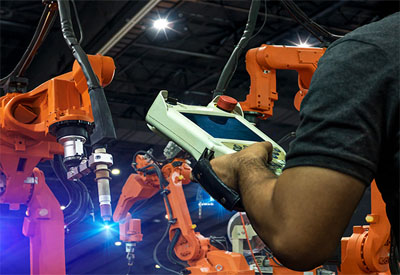
This boost in productivity, made possible by the well-connected factory floor, translates to reduced downtime, better use of redundant equipment and production cells and, ultimately, more productivity.

Efficiency

More productivity yields more efficiency. Efficiency, as a basic concept, is output relative to input.  When output is increased through connectivity and complex networks made possible by IIoT, inputs may be measured, monitored and better controlled.  With improved measurement, monitoring and control comes optimization of the primary components of manufacturing — materials and labor. Optimizing all inputs into the manufacturing cell enables manufacturing leadership to be most resourceful: using just what is needed to meet production goals.

Efficiency also means conserving another critical resource: energy.  For example, when data gathered from an IIoT-enabled factory is processed, it can tell an operator how many injection molders should      be running, which pumps should be on or off at which times, and where other energy consumption can be curtailed. A well-connected production line, enhanced by useful data, can greatly improve energy efficiency, which is another critical step on the quest for lower operational costs.

IIoT positively impacts the efficiency of the factory of the future by helping operators make smart decisions, automating equipment and systems and controlling the inputs required to meet production goals and objectives efficiently. Allied2
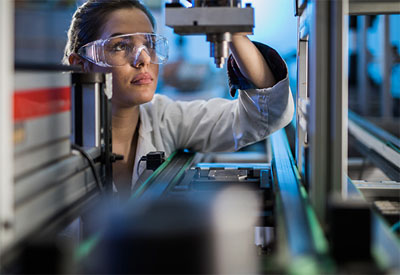
The factory of the future, however, must accomplish more than just productivity and efficiency. It needs to represent quality in what it produces. This is even more true for companies competing in an aggressive global market that demands superior quality. Implementing IIoT can help in this effort.

The integrity of the underlying system components and equipment are finely shaped, tuned and programmed to meet product specifications thanks to connected devices and complex networks in IIoT landscapes.

Data drives quality control by making maintenance timely and fitting.  Improved maintenance ensures equipment performs as expected and required, allowing products to meet specifications with superior quality.  But data also affords visibility and control – which enables better monitoring of product quality.

With a robust quality control program, improved and enhanced with connected devices and remote platforms, the factory of the future may achieve unprecedented quality goals.

Bringing It All Together

The factory of the future interlinks productivity with efficiency and quality.  The game-changer, however, is factory automation and high-speed connectivity, made possible by components with new capabilities.  As Allied’s Hank Graham says, “When it all comes together, the factory of the future becomes a customized manufacturing facility with real-time production networks that get results.

Source

Related Articles

  • | | |

    Convergix: 4 Ways Factory Automation Improves Supply Chain Management

    Although the disruptions caused by the Covid-19 pandemic revealed the fragility of global supply chains, factory automation has stepped up to mitigate many of those shortcomings. Since the onset of the Covid-19 pandemic, manufacturers worldwide have become acutely aware of the interconnectivity of supply chains. More recent issues such as international trade disputes and labor shortages have only reinforced that there are vulnerabilities every business within a supply chain has to face from time to time. Shortages of critical supplies have exposed vulnerabilities that have shut down production centers, even as demand for certain products has boomed. For many businesses, these challenges have focused on their current supply chain management practices, turning improvements into a critical strategic objective.

  • | |

    How Voltage Presence Indicators Transform Industrial Electrical Safety

    Electrical safety in industrial environments requires more than basic protocols—it demands reliable systems that provide clear visual confirmation of electrical status. The REMLIVE RL-24i series from Fortress Safety addresses this critical need by offering technicians immediate, accurate information about electrical systems before maintenance begins. The REMLIVE RL-24i Isolator Check provides the user with a positive check when isolating plant. It provides electrical isolation between the DIN rail unit and the door mounted display unit. This fundamental safety function eliminates dangerous assumptions about electrical status during maintenance procedures. The door unit is designed to fit through the front of a control panel or switch so the user can see a live/isolation status. The super bright REMLIVE RL-24i display provides the user with a quick and easy method of proof of isolation in lock out / tag out procedures.

  • |

    Design Systems Canada Provides Insights on the Future of Supply Chains in Canada

    The current state of Canadian manufacturing and its intricate supply chain is one of significant change. Over the past few years, global events have exposed vulnerabilities, forcing us to rethink how we move goods and materials. The reality is stark: relying solely on distant, complex supply lines leaves businesses exposed. Recent disruptions have taught us that lesson.  Within these challenges lie significant opportunities. Currently there is a powerful shift towards supply chain resilience; a concept that goes beyond simply recovering from setbacks. It’s about building systems that anticipate and withstand shocks. One crucial strategy gaining traction is nearshoring. Bringing production closer to home not only reduces lead times and shipping costs but also strengthens local economies. Consider this: a recent study by the Canadian Manufacturers & Exporters (CME) indicated that 78% of Canadian manufacturers are actively exploring or have implemented nearshoring strategies. This trend isn’t just a fleeting response; it’s a strategic move to build long-term stability. The role of Supply Chain Ontario and similar initiatives cannot be overstated. These programs are vital in fostering collaboration, providing resources, and driving innovation. They are helping businesses navigate the complexities of modern supply chains, from implementing advanced technologies to optimizing logistics. But what about the future? How can Canada truly solidify its position in the global marketplace? It’s about more than just reacting to crises. It’s about proactive planning, embracing technology, and fostering strong partnerships.

  • | | |

    From Ideation to Maturity: Digitalization’s Impact on the 7 Stages of a Product Manufacturing Lifecycle

    Digitalization has become a cornerstone for success in today’s manufacturing business environment. By leveraging digital tools and technologies, manufacturers can streamline operations, enhance production efficiency, and make data-driven decisions that propel their operation forward. No matter the stage in which a product manufacturing company may operate, digitalization can play a pivotal role. From accelerating product development and market entry to optimizing production at scale and extending product manufacturing life, digitalization in manufacturing offers numerous benefits that can significantly impact a manufacturer’s bottom line and growth.

  • ABB Robots Increase Automation in Solar Industry

    To enable the transformation to a sustainable society and preserve resources, production of solar collector panels must be precise, highly efficient and cost effective. To achieve this, Absolicon and ABB have developed the world’s only complete solution for the mass production of concentrated solar collectors, in Absolicon’s factory in Härnösand, Sweden.


Changing Scene

  • MacKinnon Magnetics Announces Resilient Sales Corporation as Their Newest Sales Agency Partner

    MacKinnon Magnetics Announces Resilient Sales Corporation as Their Newest Sales Agency Partner

    MacKinnon Magnetics is pleased to welcome Resilient Sales Corporation as their newest sales agency partner. Resilient Sales will represent MacKinnon Magnetics across Northeastern Ontario, including the Districts of Muskoka and Parry Sound. Key markets include Sudbury, North Bay, Timmins, Kirkland Lake, Sault Ste. Marie, Huntsville, Bracebridge and Parry Sound. This partnership expands MacKinnon Magnetics regional… Read More…

  • Canada Controls Announces the Grand Opening of Their New Edmonton Branch

    Canada Controls Announces the Grand Opening of Their New Edmonton Branch

    Canada Controls is excited to officially celebrate the Grand Opening of their new branch in Edmonton, Alberta! Join them on September 10th from 10 AM–4 PM as they welcome customers, partners, and friends to their newest location. Come meet the team, connect with their industry partners, and enjoy some great food. Most importantly, Canada Controls… Read More…


Sponsored Content
The Easy Way to the Industrial IoT

The way to the Industrial IoT does not have to be complicated. Whether access to valuable data is required or new, data-driven services are to be generated, Weidmuller enables its customers to go from data to value the easy way. Weidmuller’s comprehensive and cutting-edge IIoT portfolio applies to greenfield and brownfield applications. Weidmuller offers components and solutions from data acquisition, data pre-processing, data communication and data analysis.

Visit Weidmuller’s Industrial IoT Portfolio.


ADVANCED Motion Controls Takes Servo Drives to New Heights (and Depths) with FlexPro Extended Environment Product Line

Advanced Motion Controls is proud to announce the addition of six new CANopen servo drives with Extended Environment capabilities to their FlexPro line. These new drives join AMC’s existing EtherCAT Extended Environment FlexPro drives, making the FlexPro line the go-to solution for motion control applications in harsh environments.

Many motion control applications take place in conditions that are less than ideal, such as extreme temperatures, high and low pressures, shocks and vibrations, and contamination. Electronics, including servo drives, can malfunction or sustain permanent damage in these conditions.

Read More


Service Wire Co. Announces New Titles for Key Executives

Bruce Kesler and Mark Gatewood have been given new titles and responsibilities for Service Wire Co.

Bruce Kesler has assumed the role of Senior Director – Business Development. Bruce will be responsible for Service Wire’s largest strategic accounts and our growing Strategic Accounts Team.

Mark Gatewood has been promoted to the role of Vice President – Sales & Marketing. In this role, Gatewood will lead the efforts of Service Wire Company’s entire sales and marketing organization in all market verticals.

Read More


Tri-Mach Announces the Purchase of an Additional 45,000 sq ft. Facility

Tri-Mach Elmira Facility

Recently, Tri-Mach Inc. was thrilled to announce the addition of a new 45,000 sq ft. facility. Located at 285 Union St., Elmira, ON, this facility expands Tri-Mach’s capabilities, allowing them to better serve the growing needs of their customers.

Positioning for growth, this additional facility will allow Tri-Mach to continue taking on large-scale projects, enhance product performance testing, and provide equipment storage for their customers. The building will also be the new home to their Skilled Trades Centre of Excellence.

Read More


JMP Parent Company, CONVERGIX Acquires AGR Automation, Expanding Global Reach

Convergix Automation Solutions has completed the acquisition of AGR Automation (“AGR”), a UK-based provider of custom, high-performance automation design and systems integration primarily to the life sciences industry.

Following Convergix’s acquisitions of JMP Solutions in August 2021 and Classic Design in February 2022, AGR marks the third investment in Crestview’s strategy to build Convergix into a diversified automation solutions provider targeting the global $500+ billion market, with a particular focus on the $70 billion global systems integration and connectivity segments. Financial terms of the transaction were not disclosed.

Read More


Latest Articles

  • Electromate: Spring Applied & Power-Off Permanent Magnet Brakes – Engineering Failsafe Motion Control

    Electromate: Spring Applied & Power-Off Permanent Magnet Brakes – Engineering Failsafe Motion Control

    Most electromagnetic brakes work on a simple logic: apply current, apply braking. Remove current, release braking. For many industrial applications, conveyors, packaging lines, printing machines, this is exactly the right behavior. The brake engages on demand and releases when not needed. But for a significant class of machines, this logic is exactly backwards. Robots, vertical… Read More…

  • ITC 101 Series: Why Certifications (UL, CSA) Matter in Industrial Components

    ITC 101 Series: Why Certifications (UL, CSA) Matter in Industrial Components

    When selecting industrial electrical components, certification is more than a logo on a datasheet. A certification mark indicates that a product or component has been independently evaluated against specified requirements for its intended market. In North America, selecting products with the appropriate certification can affect regulatory acceptance, equipment certification, inspections and project completion. The key… Read More…