PULS: MCB vs eFuse – Which Is the Best Solution for Properly Securing DC Circuits?
February 12, 2026
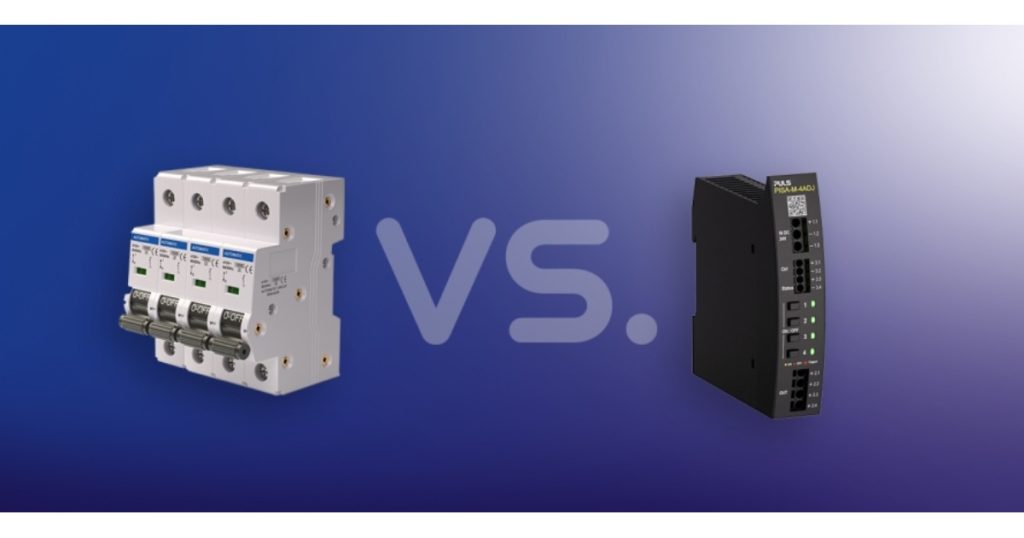
MCB vs eFuse: Which Is the More Reliable Protection Mechanism
By: Abdul Ücüncü, Application Engineer, PULS
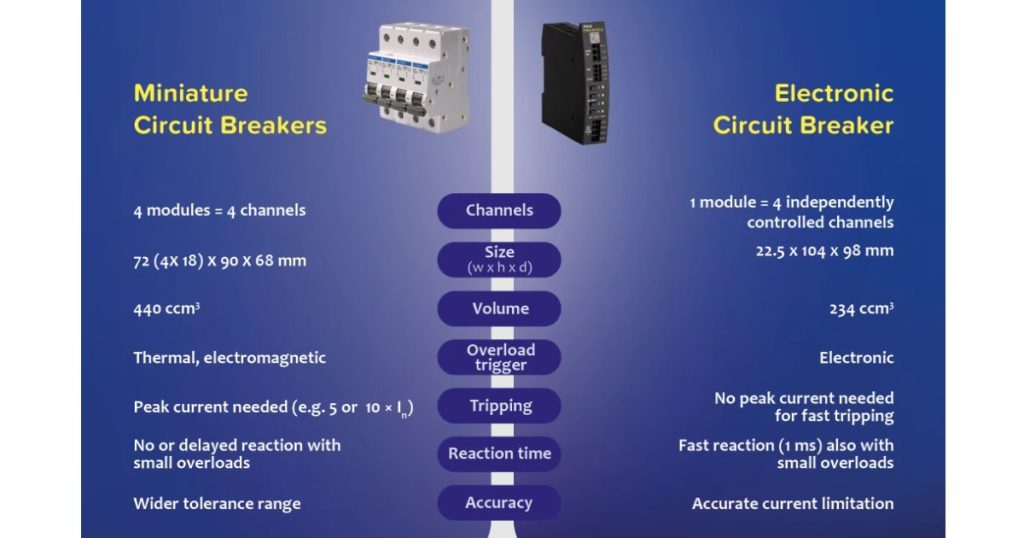
This blog article compares a traditional miniature circuit breaker (MCB) and an electronic circuit breaker (ECB) with integrated eFuses, highlighting the advantages of an ECB in terms of faster and more reliable tripping without the need for peak current.
In times of unregulated transformer power supplies, traditional miniature circuit breakers (MCB) have established themselves as the main protection modules. However, when primarily switched-mode power supplies were introduced in the 1990s, they quickly replaced transformer power supplies in industrial applications.
The new technology enabled more efficient and compact power supplies that better met the increased demands of the industry. The era of transformers was thus over, but the MCBs remained and continued to be used in conjunction with switched-mode power supplies, even on the DC side. However, there are now much better and, above all, more reliable protection mechanisms, such as electronic circuit breakers.
MCB vs. eFuse
The biggest challenge is that miniature circuit breakers were originally designed for the AC-side of the application and require multiple times the nominal current for a few milliseconds to trip. Many switched-mode power supplies cannot provide this, as they shut down on the DC side during a high current pulse to protect themselves and the connected loads.
The alternative to the classic miniature circuit breaker (MCB) is an electronic circuit breaker (ECB) with integrated eFuses. These modules, such as PULS’s PISA models, are optimised for the distribution and protection of DC loads and do not require peak current for reliable and quick tripping. The reaction time, even with slight overload, is within 1 ms.
This article explains some differences between MCBs and ECBs in detail, which can help you choose the right solution.
Choosing the right MCB requires a precise understanding of the application and careful system planning. With an ECB, this effort can be significantly reduced.
Abdul Ücüncü, Application Engineer, PULS
Approval: MCB on the DC Side Only with IEC 60947-2
Most circuit breakers were developed for the protection of AC circuits. The idea that the same technology can also protect DC circuits is a misconception.
The main reason is that the arc burning and arc extinguishing properties of AC and DC systems are different. An AC circuit breaker may not reliably trip in a DC circuit. Therefore, if you want to use an MCB on the DC side in industrial low-voltage systems, it must comply with the IEC 60947-2 standard. This standard applies to MCBs whose main contacts are intended for connection to circuits with rated voltages in the low-voltage range of 1,000 VAC or 1,500 VDC.
Tripping Characteristic: B, C or Z?
When selecting a circuit breaker, it is important to look at the tripping characteristic. There are different tripping characteristics suitable for various industrial applications. However, to reliably protect a DC circuit, it is advisable to use an MCB with the Z tripping characteristic.
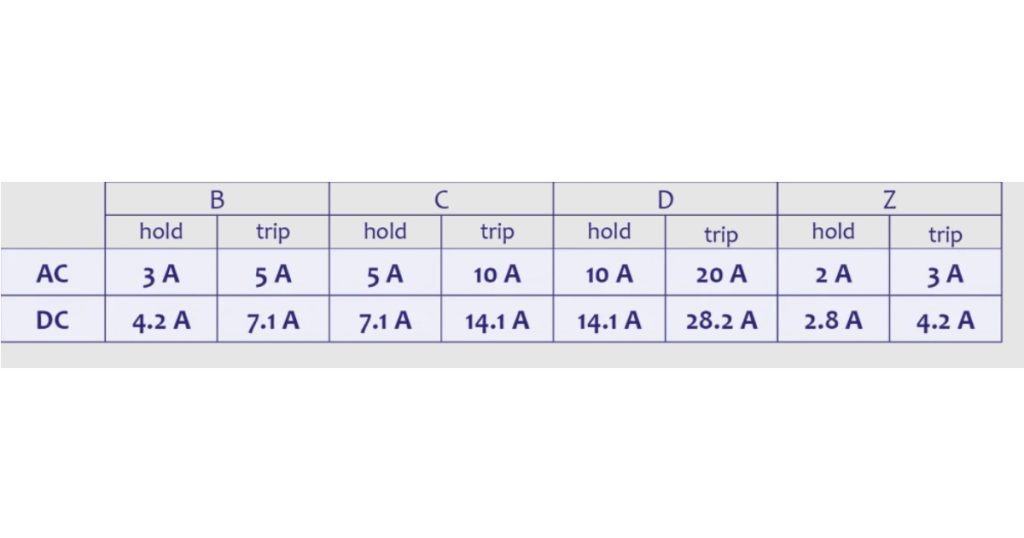
Since circuit breakers with this tripping characteristic are more expensive, MCBs with the B or C tripping characteristic are mostly used in practice. As the graph shows, circuit breakers with a Z characteristic trip at 2 to 3 times the nominal current and are significantly faster than MCBs with a B characteristic, which trip at 3 to 5 times the nominal current, or even a C characteristic, which requires 5 to 10 times the current.
With an electronic circuit breaker, the selection of the tripping characteristic is much more flexible. As part of PULS’s PISA-M series, they offer an “adjustable” version where the tripping currents and characteristics can be flexibly adjusted. Thus, the tripping speed can be chosen between a fast (max. 2 ms) and a slow (max. 10 ms) characteristic.
The current values can be individually set for each of the 4 channels, as long as the total current does not exceed 20 A. With ECBs, users can respond much more flexibly to different loads or system expansions.
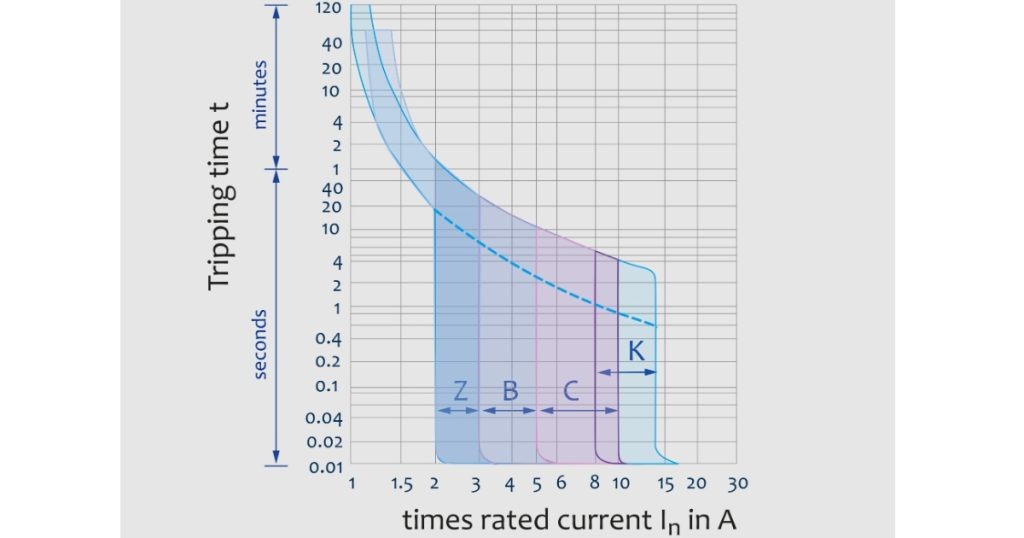 MCB: Tripping curves for B, C, Z and K characteristics
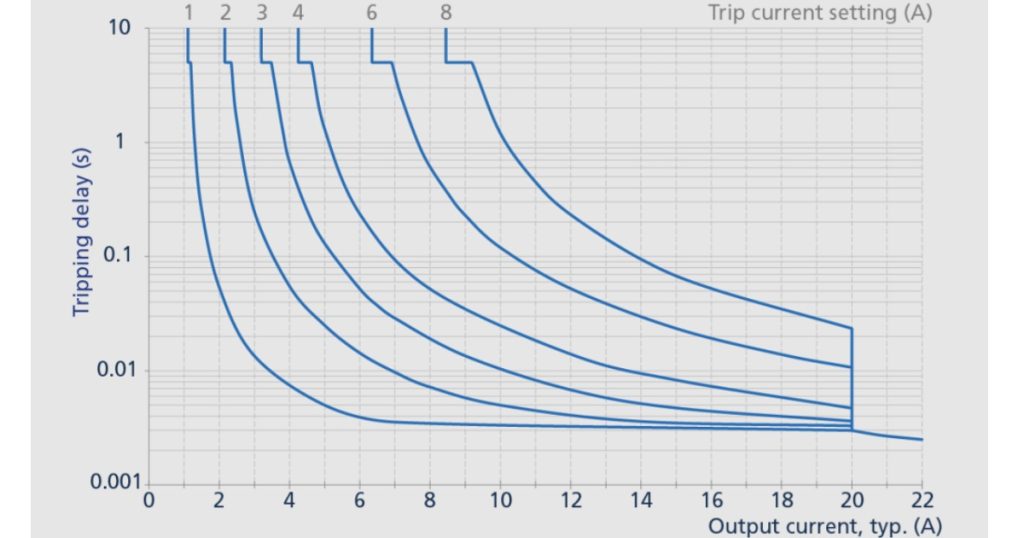 ECB: Tripping delay depending on current fast tripping characteristic.
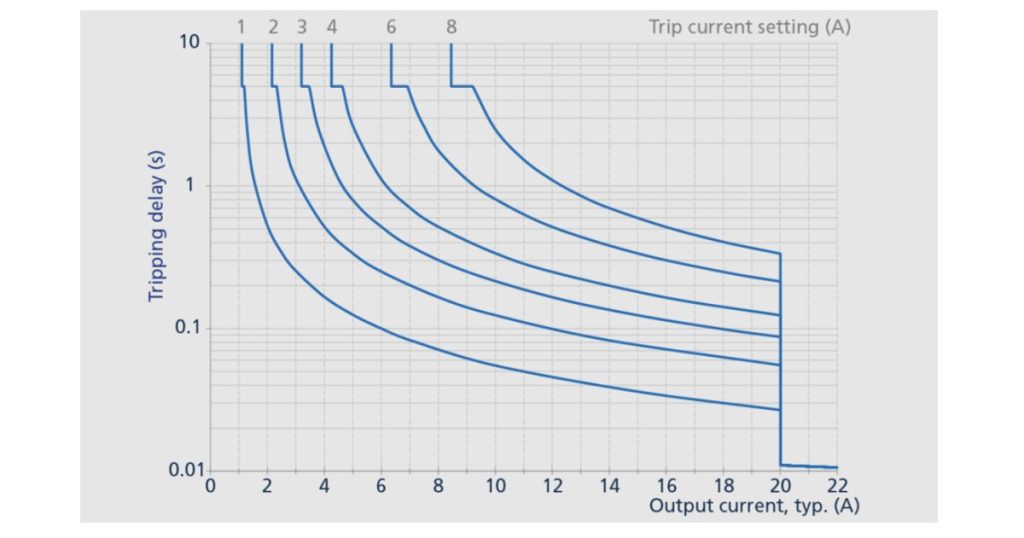 ECB: Tripping delay depending on current slow tripping characteristic.
Tripping Mechanism: Thermal & Magnetic or Electrical?
A circuit breaker has two types of tripping mechanisms integrated: thermal and magnetic tripping mechanisms.
The thermal fuse is responsible for tripping the circuit breaker in case of overload. Depending on the current level, tripping can take from a few seconds to 1-2 hours. The bimetal in the circuit breaker is responsible for the thermal tripping. When the current in the circuit breaker exceeds the nominal value, the bimetal heats up and deforms, triggering the shutdown mechanism. Since the current has the same thermal effect on both DC and AC sides, the thermal tripping works the same under defined environmental conditions for both DC and AC.
The magnetic fuse is responsible for the short-circuit tripping of the circuit breaker. It is supposed to trip within a few milliseconds in a specific tripping range (each tripping characteristic has its own range). The coil in the circuit breaker is responsible for this. When a very high current flows, a strong magnetic field is formed, which trips the switch.
Since the peak value of the alternating current determines the size of the magnetic field, a correction factor for the magnetic tripping must be taken into account when using a circuit breaker in DC circuits. This correction factor is √2 or 1.41. The immediate tripping ranges for circuit breakers with different tripping characteristics are described below.
An electronic circuit breaker, on the other hand, enables simpler and more precise tripping of the channels. The ECB continuously measures the current, and the integrated eFuse reliably and quickly trips at the defined current value. This process works independently of external influences, such as ambient temperature, which is a significant advantage over MCBs. An ECB directly contributes to higher system availability.
Temperature Dependence and “Rated Diversity Factor”
As explained with the thermal fuse, the bimetal responsible for tripping is temperature-dependent. This means: the higher the ambient temperature, the more the bimetal heats up and trips earlier. High ambient temperature leads to the maximum nominal current flowing through the circuit breaker needing to be reduced to prevent unwanted tripping. Conversely, at low temperatures, a higher current must flow to sufficiently heat the bimetal to trip the circuit breaker.
The installation situation in the control cabinet can also affect the thermal fuse. When multiple circuit breakers are operated side by side without spacing, thermal interaction occurs between them. The circuit breakers heat each other, which means the maximum nominal current of the circuit breakers must be reduced again. How much the current needs to be reduced due to increased temperature of the MCB in such cases is specified by the manufacturer and referred to as the Rated Diversity Factor (RDF).
Electronic circuit breakers, on the other hand, are temperature independent. The operating temperature of the PISA-M is between -25 °C and +70 °C at full output power, i.e., without derating. A Rated Diversity Factor is not necessary.
The modules can also be installed in the control cabinet without minimum spacing to other PISA-M units. Only a minimum distance of 15 mm to heat sources, such as the power supply, must be maintained.
Choosing the Right Power Supply Unit
Just as important as selecting the right circuit breaker is the decision for the appropriate power supply unit. This aspect is often overlooked.
Practice shows that the short-circuit current of a 10 A power supply for a total load of 7 A may not be sufficient to trip the MCB and isolate the faulty load. Because with a load of 7 A, a 10 A MCB is usually used. This means that if an MCB with the B characteristic is used, the 10 A power supply would need to provide between 30 A and 50 A as short-circuit current to trip the MCB. Most 10 A power supplies cannot provide this much current, as they shut down for self-protection beforehand. As a result, all loads connected to the power supply are no longer supplied, even if they do not have a fault.
To avoid this problem, a power supply with a fuse-breaking feature can be used, which provides 5-6 times the nominal current for a few milliseconds. Alternatively, the power supply must be oversized. This means using a higher power class. Both solutions have their disadvantages: users may pay for functions they do not need, and a larger power supply requires more space in the system. Even with a perfectly matched power supply to the MCBs, it may happen that the short-circuit current is not sufficient to trip the circuit breaker – for example, if the total resistance of the short-circuit path is too high.
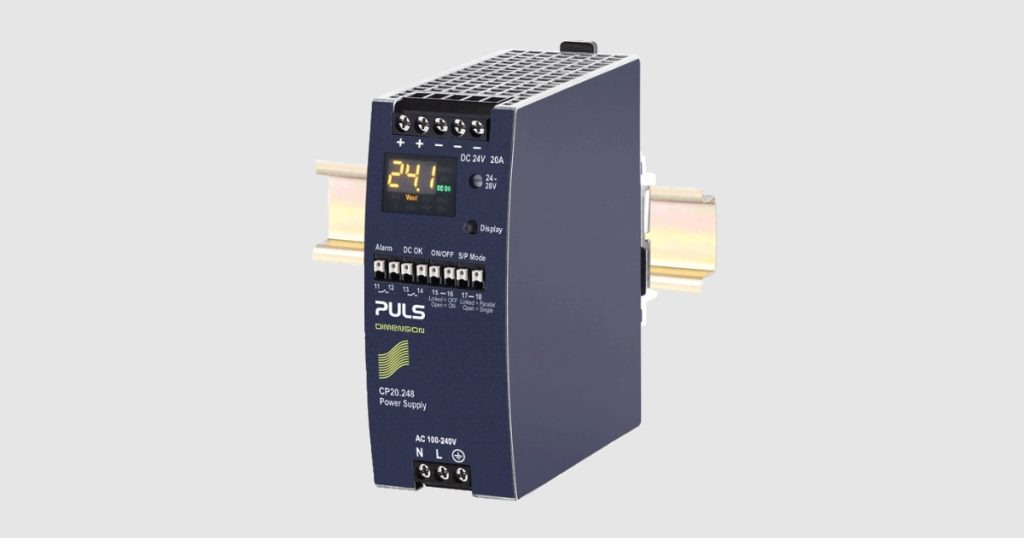
If you want to combine a power supply with an electronic circuit breaker, only the available maximum output current of the power supply is relevant for the decision. For an ECB of the PISA-M type, PULS recommends a power supply with at least 90 W output power. The selection is thus much more flexible.
Summary
Choosing the right circuit breaker requires a precise understanding of the application and careful system planning. All this takes time, engineering resources, and ultimately money.
With every small change in the application, it must be determined again whether the circuit breakers still provide sufficient protection for the existing loads. With an electronic circuit breaker, this effort can be significantly reduced. In addition to wiring, only the configuration of the output currents needs to be done.
PULS’s PISA modules with integrated eFuses protect loads by reliably tripping affected channels, regardless of the load, temperature, power supply, or total resistance of the short-circuit path.
For more information on PULS solutions HERE


MCB vs eFuse MCB vs eFuse MCB vs eFuse MCB vs eFuse MCB vs eFuse MCB vs eFuse MCB vs eFuse MCB vs eFuse MCB vs eFuse MCB vs eFuse MCB vs eFuse MCB vs eFuse MCB vs eFuse MCB vs eFuse MCB vs eFuse