Schneider Electric Canada Leverages AI to Help Buildings Reach Net-Zero Without Full Scale Rebuilds
September 29, 2025
Schneider Takes a Multi-Pronged Approach to Leverage AI to Identify Energy Inefficiencies in Homes, Commercial & Industrial Institutions
By: Krystie Johnston
Schneider Electric Canada is leveraging artificial intelligence (AI) to transform energy management across various end markets. To help buildings in Canada reach net-zero, Schneider takes a multi-pronged approach to leverage AI to identify energy inefficiencies in homes and commercial and industrial institutions and monitor and adapt the technologies that are implemented in them to reduce emissions.
Buildings in Canada & Their Connection to Net-Zero
“The building sector in Canada is quite diverse, and from a Schneider Electric standpoint, we look at all buildings. We look at residential buildings like single family homes or mixed-use dwellings, and we look at commercial, retail, institutional, and industrial facilities as well,” says Richard Henzie, Director of the Smart Building Division at Schneider Electric Canada.
“If you look at some of the statistics globally, buildings in general account for up to 37% of carbon emissions,” he says. This is a significant contribution, but the good news is, there are lot of ways to reduce this number: decrease the amount of embodied carbon in new builds and minimize the operational emissions every building produces when they consume energy. Henzie says Schneider has solutions and strategies to help these different types of buildings better manage their operational emissions, with the added benefits of creating a more comfortable atmosphere in any building and saving money.
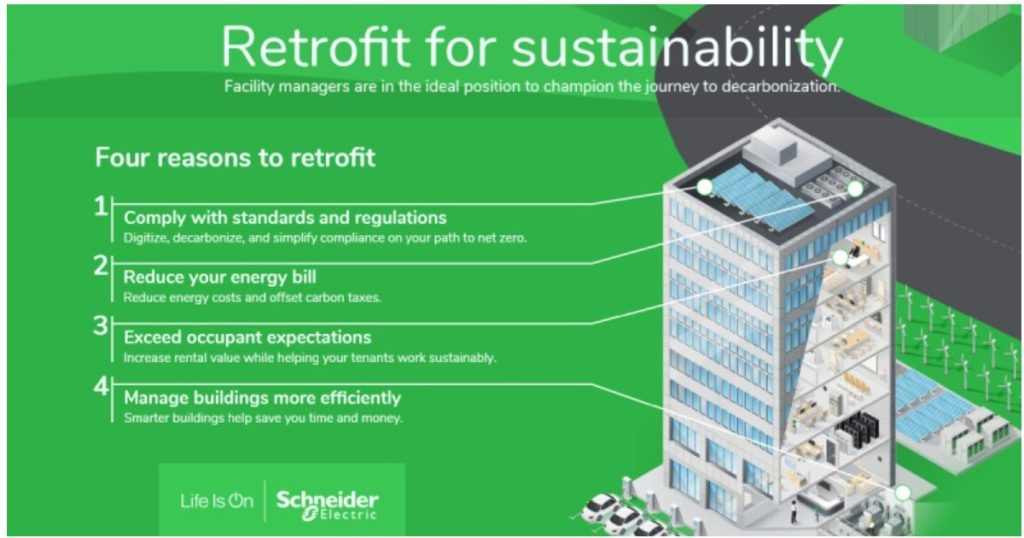
Buildings that are 20 or 30 years old were not constructed the same way they are today.
“Often, when they were built, they were not built with energy optimization or energy efficiency in mind. They typically have outdated mechanical systems and insufficient insulation,” Henzie says.
Buildings today are constructed to meet certain standards, such as LEED or WELL, that use performance-based systems to focus on the wellbeing of the environment and human health. New buildings integrate net-zero targets into the entire process, from the design to construction to the operation of a building.
Light, Medium & Deep Retrofits to Reduce Carbon Emissions
Owners or operators of existing buildings can focus their efforts on reducing the operational emissions of a home, school, office, or facility. And this is where Schneider Electric can help, with what Henzie describes as light, medium, or deep renovations. A light intervention is a good starting point to establish a baseline. This baseline is achieved through installing ways to measure the current state, such as energy meters.
Getting an understanding of a building’s energy consumption is number one. Henzie says that they can also bring in advanced controls; they can upgrade a building’s energy management system or install more sensors to collect data that can be leveraged to improve the overall operation of the building or occupant comfort. All this can be coupled with Schneider’s consulting services, enabling a building owner or operator to better understand how they are performing today in terms of energy efficiency, what actions they can take to improve it, and what impact that will have.
Medium and deep renovations take this a step further. Henzie says that in a medium retrofit, equipment starts to get replaced, like a building automation system or mechanical systems that are not operating efficiently enough. And deeper renovations involve electrification of key systems, transitioning away from fossil fuels, or replacing windows and insulation.
“A much bigger expense when you look at the renovation, but the longer-term impact is you reduce your carbon emissions significantly more than just doing a light intervention.”
AI Transforms Energy Management with Data Contextualization & Transparency
To support these interventions and transform energy management in buildings, Schneider is leveraging AI in several ways. Henzie says AI has the potential to disrupt this market by exponentially altering the capabilities of traditional solutions available and using copious amounts of data that was impossible to contextualize until recently.
“You can imagine that by leveraging AI, we now can analyze energy information, patterns, and identify inefficiencies through a technology-based approach. Whereas in the past, that might have been someone walking through a building and visually observing how that building is operating but cannot actually see [emphasis added],” he says.
“Now, having all that data gives us much better insight into how that building is performing. Now, we can model different scenarios. For example, by entering data into an AI model and starting to scenario-plan different retrofit-type scenarios and being able to predict the emissions that are going to be achieved through those different scenarios, this gives us much better insight in advance of going through those different light, medium, or deep renovations,” Henzie adds.
Not only is Schneider Electric leveraging data and AI to gain better insights and predictability in terms of the impact various retrofits will have on any given buildings’ emissions, but Henzie says they are also implementing it to monitor and adapt these retrofitted technologies to optimize efficiency.
“When you look at the overall operation of a building, we are now able to leverage AI to almost achieve an autonomous building state. You are able to take in information – whether it be from the building, the occupants, the outdoor air temperature and weather forecast – and integrate it to tune the building to a level that it can make its own decisions on what actions it should be taking at certain times of the day, requiring less intervention or operation from the building operator or owner, and really allowing the system to do more of that operation.”
What Makes Schneider Electric a Good Partner for Energy Transition
Schneider supports the entire lifecycle of building projects, from initial scope and design to monitoring and optimization. And they help their customers and partners to make the most of their resources by providing an open portfolio that accommodates other vendors and utilizes what already exists without having to completely rip and replace. Henzie says they even leverage their own technology to better manage and operate their own buildings and facilities and that this internal experience is transferred to their customers. “We have a strong commitment to net-zero leadership ourselves. We have been named Time Magazine’s ‘Most Sustainable Company’ two years in a row, for example.”
Adding to this, Henzie says Schneider Electric works locally and globally to be a leader in sustainability:
“We also work upstream with municipalities, utilities, and government organizations in terms of helping shape regulation and incentives and funding models that will help a lot of these building owners and operators access funding they would not normally have to be able to contribute towards these retrofits,” he says. “We are actively engaged at the market level as well in terms of helping shape what that future looks like.”
Although Schneider Electric has a broad technology portfolio that supports the automation and management of buildings, Henzie says that two solutions stand out as being particularly useful in helping homes and businesses reach net-zero, both of which fall under their EcoStruxure offering: EcoStruxure Building Advisor and EcoStruxure Building Operation. Both work independently and together to leverage AI to help buildings reduce their emissions.
EcoStruxure Building Advisor & EcoStruxure Building Operation
“When we talk about AI today, we are doing it right now. We have a software service, EcoStruxure Building Advisor], that we deploy which can essentially collect data from any building automation system – it does not have to be a Schneider Electric system – and run that data through our building models and algorithms and generate a view of that to the building owner and show [them] where they have inefficiencies within their mechanical system,” Henzie says. “It could be certain pieces of equipment are not working properly, it could be vents are closed that should be open, anything within the system that could be causing an inefficiency is flagged to the operator.”
Using this information, Schneider uses EcoStruxure Building Operation – their core integration platform when it comes to buildings to looks at things like HVAC, lighting, energy management, access control, security, etc. – and it does the complete base building automation. Henzie says they use this platform to present what interventions are required, whether equipment needs to be maintenance or replaced, the ROI of these interventions.
“We have provided significant savings that have been generated out of this solution, whether it be within a school district, an airport, or in a lot of cases, commercial office buildings, we have helped reduce consumption up to around 30% with that service.”
Conclusion
Artificial intelligence is transforming many markets, including the buildings segment, which is leveraging AI to transform energy management by identifying inefficiencies and autonomously adjusting technologies to optimize them. Traditional approaches to energy management are no longer an option; it is imperative to leverage the data from building systems and use an integrated approach to drive insights into where opportunities exist to reduce energy and emissions. Schneider Electric has a complete portfolio and global experience that can guide their customers along this journey.
More Information
Interested in learning more? Visit Schneider Electric Canada today!


Net-Zero Net-Zero Net-Zero Net-Zero Net-Zero Net-Zero Net-Zero Net-Zero Net-Zero Net-Zero Net-Zero Net-Zero