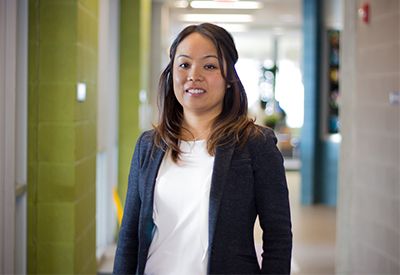
Jenny Ng – Business Development Manager, Schneider Electric Power Solutions Division
December 16, 2019
By Blake Machand
Jenny Ng is a Business Development Manager for the Power Solutions Division of Schneider Electric. Thus far, she has spent the whole of her career in the energy sector in various roles. She has spent time with utilities as a telecom engineer, in technology and product development with General Electric, and prior to her current position, she was Field Services Marketing Director with Schneider.
“This experience has given me the full perspective of what it takes to truly bring new technology from concept to implementation,” she said, “I enjoy marrying both the technical and business mindset to help our customers solve their unique problems.”
Jenny continued to explain her approach professionally, “I am a solid believer of the lean start-up mentality, which is a methodology for developing businesses and products that aims to shorten product development cycles and rapidly discover if a proposed business model is viable. Trying, failing fast, learning from the mistakes and continuously pivoting my approach until I get it right has also been key to my success.”
Jenny earned a degree in Electrical Engineering from the University of Alberta. Not entirely fulfilled, she would go back to school to get an MBA from Queens University. “Growing up, I was exposed to an entrepreneurial mindset as my dad owned several small businesses. Seeing the excitement and challenges he faced daily inspired me to take on a more business-mindset,” she noted.
Being in a leadership position, Jenny has also focused on being an inclusive role model, which has manifested on multiple fronts. Maintaining an enlightened managerial style, fostering social responsibility, and promoting gender diversity. She explains, “I am a leader who thrives on continuous self-improvement and creating a positive environment around me to drive change. In my current role, I get to inspire new system integrators by training them on new technology that is available so that they can provide better solutions to their customers. These solutions ultimately help provide their customers a safer work environment, achieve their sustainability goals, and improve the reliability of their power systems. “
“Internally, to drive positive change, I am the chair of the WiSE (Women in Schneider Electric) Toronto Hub where we organize awareness, business impact and development events and activities to support the women in Schneider Electric and in our community.”
It is clear that Jenny’s professional approach is one of balance. Promoting an inclusive working environment on multiple levels to create a dynamic inducive to innovation. While also being mindful of industry’s impact on the environment and the need to preserve the planet’s resources. Something that Schneider takes seriously, in respect to the products and solutions it provides as well as the way it operates as a business.
“I think we need to continue to collaborate and not focus on building everything ourselves. We recently launched Schneider Electric Exchange, a collaboration platform that promotes collaboration with users, system integrators, and technology providers,” she explained.
“My clients can now develop innovative technology or modules and share it with the world, the idea or technology is no longer locked into a specific geography and those who can benefit can connect with these partners developing business together.”
In Panel Builder and Systems Integrator’s interview with Jenny, she discussed her current role and how she finds meaning in her professional career. In the process she provides a sophisticated perspective on success. While also providing insight into the technical side of the industry. Touching on the importance of collaboration to achieve a sustainable energy future, trends driving the industry, as well as why diversity, inclusion, and promoting women in STEM is important to her and the broader industry.
Can you tell me a bit about your current role: what interests you, what challenges you, etc.?
Working for a technology company that serves a meaningful purpose is important to me. Schneider Electric believes access to energy is a basic human right, and strives to bring sustainable, efficient energy and digital connectivity to all, which I feel is vital for us as a global community moving forward. Equally important for me is to work in a diverse and inclusive environment that drives empowerment. At Schneider Electric, diversity and inclusion is an integral part of the Company’s history, culture, and identity. Our ambition is to provide equal opportunities to everyone everywhere and to ensure all employees feel uniquely valued and safe to contribute their best. This is something that resonates with me and makes me feel proud to be a part of such a diverse and inclusive Company.
In my current role as a Business Development Manager for the Power Solutions Division, I am responsible to develop and implement a partner strategy to grow our business with our System Integrator partners in Canada. This includes many responsibilities such as market research, developing the strategy and the program, partner recruitment, technical and commercial training, promoting and selling, design and quoting, and supporting our partners with executing our solutions. What I enjoy most about this role is the opportunity to meet many businesses with different profiles around Canada and working with each of them to drive positive change and a winning strategy.
What is pertinent right now with respect to business development in the power sector, what are the aspects you are focusing on to ensure Schneider Canada is successful?
The electrical industry is transforming rapidly with a growing need to digitally manage the electrical network. Canada is the second largest country geographically in the world, making it challenging for any one organization to cover the electrical transformation needs of everyone, everywhere. Thus, identifying, recruiting and supporting strong partners with the ability to engage with customers, understand their unique power challenges and to propose customized solutions is important. There are currently many opportunities in the power sector with customers looking to reduce their carbon footprint, increase system reliability, improve safety for their employees who are maintaining the power networks, and even taking advantage of lucrative incentive programs to reduce their energy consumption during peak periods. Schneider offers many different technologies and solutions which can help solve these challenges, from intense power consumers and critical facilities to commercial and residential households.
Can you perhaps touch on some of the technologies, trends, products, etc. that are influencing Schneider’s direction, right now?
Power distribution is changing as the world becomes more digital. Climate change is undisputedly impacting our planet’s invaluable but, finite resources. How do we strive for economic growth while minimizing our impact to the environment? The following two trends that I see are helping solve this dilemma. First, the energy mix is shifting and becoming more electric and more renewable. Secondly, the power industry is also becoming more and more digitized. By 2025, 75% of the workforce will be from the digital generation and there will be 10x more connected devices than people.
Schneider Electric is focused on offering different digital power solutions including connected devices, edge controls, cloud applications, analytics and services to help our customers achieve safer, more efficient and sustainable power. Every customer has their unique power challenges, Schneider has engineered its digital solutions to be flexible, scalable, interoperable and with cyber security in mind in order to meet these custom needs.
What is next for your industry? Are there any emerging technologies, trends etc that you see as being prominent 5-10 years from now?
It is a very exciting time to be working in the power industry as there are many emerging technologies which are well positioned to disrupt this industry when fully adopted. The following are three trends that I see impacting the power industry:
- Artificial Intelligence (AI) – There has been a lot of buzz around AI and the potential it has to help organizations become more efficient and profitable by looking at data patterns not obvious to the human eye. We have already seen many large tech organizations like Apple, Google, Amazon, Microsoft invest in AI-related technologies in providing solutions targeting consumers like self-driving cars, google home and Amazon’s Alexa. In the power industry AI is also being readily adopted in industries world-wide. There will be more and more applications available where power data is continually being analyzed using increasingly advanced algorithms to help operators proactively come up with better energy efficiency strategies, more reliable, safe and cyber secure power systems.
- Augmented Reality (AR) technologies – AR is an interactive experience of a real-world environment where the objects that reside in the real world are enhanced by computer-generated information. In the power industry, we are seeing AR applications helping facility operators manage their day to day operations in a more efficient and safe manner. An example of this application is by combining contextual information for mobile users in the field through a tablet interface or goggle that superimposes real time data and virtual objects onto power equipment cabinets, giving immediate access to relevant machine and process information to the operator.
- Microgrids – As the three key components to drive microgrid adoption become more mature – the technology, regulators and businesses – there will be more and more microgird adoption at scale which will take place. With the increased desire to build reliable power systems and to incorporate renewable sources, there have been many microgrid demonstration projects. A lot of these projects are moving from remote regions, military, campus-style microgrids to now being planned and deployed in cities and communities. With the increasing number of innovative applications for microgrids, Schneider Electric Canada has a smart grid lab located at Ryerson University, which serves as a hub for students, researchers, engineers and industry. It is a collaborative facility for testing and demonstrating smart grid ideas to modernize the electricity delivery system and the engagement of customers in managing their electricity usage.
Anything else you would like to add?
I believe it’s important that we as a society continue to implement and support diverse and inclusive workforces where people feel open to share their viewpoints and ideas to ensure we consider all perspectives in our decision-making process. The Power sector has been historically male dominated and missing the diversity in thought from a women’s perspective. It makes me proud to see that Schneider takes this very seriously in making real change in our work environment.
I have personally been involved in making a change by developing and leading our first Women in Schneider Electric (WiSE) employee resources group for the GTA community four years ago, where our mission is to create an interactive community to support women in our organization–through awareness, business impact, development and community activities–and to tackle the systemic challenge of promoting STEM fields to young girls and to help integrate immigrant women with STEM background into the workforce.