|

Enhancing Servo System Performance and Reliability: The Critical Role of Regulated Power Supplies in Modern Control Applications

June 29, 2023

In a servo system, the choice between a regulated and unregulated power supply is crucial. It can significantly impact the performance, stability, and longevity of the system.

For servo systems, it is highly recommended to use a regulated power supply due to the following technical reasons:
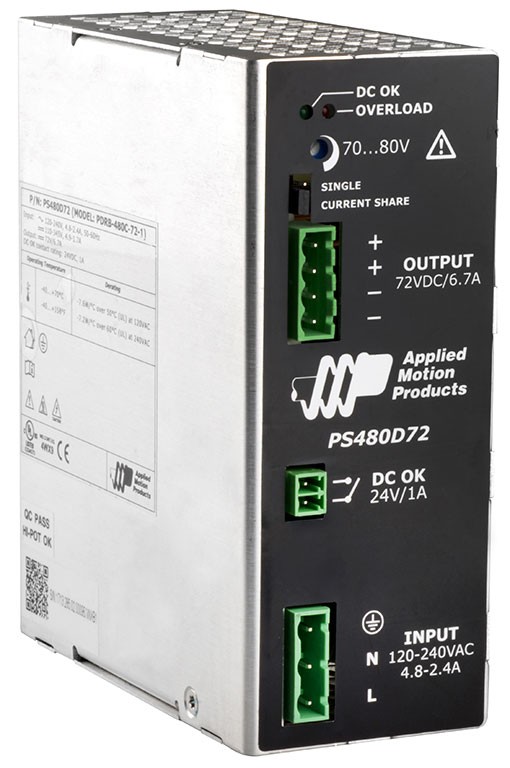
Voltage Stability: Servo systems require precise control of motor position, velocity, and torque. A regulated power supply maintains a constant output voltage within a specified tolerance, typically less than 1% variation, regardless of fluctuations in input voltage or load current. This stability is essential for preventing servo motor torque and speed variations, ensuring smooth and accurate system operation.

Load Regulation: In a servo system, the load current may vary significantly due to changes in motor speed and torque, load inertia, and dynamic forces. A regulated power supply can maintain the output voltage level within the specified range even during these variations, providing consistent performance and preventing potential control loop instability.

Line Regulation: As input voltage may fluctuate due to grid disturbances or other electrical equipment in the system, a regulated power supply compensates for these variations to provide a consistent output voltage. This ensures that the servo system operates within its specified voltage range, maintaining precise control and preventing potential damage to components.

Ripple and Noise Reduction: Regulated power supplies typically exhibit lower output voltage ripple and noise compared to unregulated ones. High-frequency noise can couple into the servo system’s feedback and control signals, potentially causing jitter, reduced accuracy, and increased settling time. By using a regulated power supply, these issues can be mitigated, providing better performance and precision.

Protection Features: Regulated power supplies often include built-in protection mechanisms such as short-circuit, over-voltage, over-current, and over-temperature protection. These features help safeguard the servo system and its components from potential damage caused by electrical faults or thermal events, increasing system reliability and lifespan.


While regulated power supplies are generally recommended for servo systems due to their stability and performance benefits, there are some cases were using an unregulated power supply might be considered advantageous. Here are some reasons why someone might recommend unregulated power supplies:

Cost: Unregulated power supplies are often less expensive than their regulated counterparts. For projects with tight budgets or where the system’s performance and stability requirements are less stringent, an unregulated power supply might be chosen as a cost-saving measure.

Simplicity: Unregulated power supplies have a simpler design compared to regulated ones, which may result in fewer components, reduced complexity, and easier maintenance. This could be appealing for systems where the potential performance trade-offs are acceptable.

Size and weight: Due to their simpler design and fewer components, unregulated power supplies can be smaller and lighter than regulated ones. In applications where space and weight constraints are critical, an unregulated power supply might be an attractive option.

Efficiency: Unregulated power supplies can be more efficient than some types of regulated power supplies, especially linear regulators. Switching regulators (stabilized power supplies) generally have better efficiency than linear regulators, but in some cases, an unregulated power supply may still offer higher efficiency depending on the load and operating conditions.

Acceptable performance in specific cases: In some situations, the performance of the servo system might not be severely impacted by the voltage variations, noise, or other issues associated with unregulated power supplies. If the servo system is less sensitive to these factors or if the application can tolerate some degree of performance degradation, an unregulated power supply might be an acceptable choice.

While unregulated power supplies might be less expensive, they can introduce instability, noise, and potential risks to the servo system. For engineers designing servo systems, a regulated power supply is the preferred choice due to its ability to provide a stable, clean, and consistent voltage supply, ensuring optimal system performance, accuracy, and longevity.


Source

Related Articles

  • | | |

    How Advanced Automation Accelerates Industrial Adoption of SMR Technology

    As the world advances toward decarbonization, industrial energy consumers are looking for solutions that go beyond renewable electricity alone. They are seeking reliable, high-temperature outputs created from sustainable (ie. non-fossil) energy sources. They are demanding flexible, always-on power. And, increasingly, they are turning to a promising innovation: Small Modular Reactors (SMRs). Unlike traditional nuclear power plants that are massive, centralized, and built primarily for the grid, SMRs are compact, factory-built, and scalable. These characteristics make SMRs ideal for industrial facilities seeking on-site energy solutions that offer both carbon-free electricity, process heat, and more. From chemical plants to data centers to water treatment facilities, industrial companies are exploring SMRs as a multipurpose energy source. The thermal output of an SMR can drive high-temperature industrial processes, fuel hydrogen production, power desalination plants, and even support district heating systems. But tapping into this potential requires more than just advanced nuclear technology—it demands a sophisticated approach to automation and control.

  • |

    ATS: Optimize Your Parts Inventory to Reduce Obsolescence Risk

    In the fast-paced world of manufacturing, unplanned downtime is a significant drain on resources and operational performance, leading to substantial production losses. Obsolescence risk is inevitable and occurs in new and old equipment. Your operation is at high risk for downtime when an original equipment manufacturer (OEM) decides to no longer produce a critical part required to run your production line and there is no available inventory of that part or plan to replace it. Proactive maintenance practices such as planned preventive maintenance (PPM) can go a long way toward reducing the occurrence of unplanned downtime events. However, when these events involve obsolete parts that are difficult to source or replace, the disruption is often prolonged. This is why a strong inventory management program and budget is imperative to manage obsolescence risk. Otherwise, the financial impact of downtime events can be catastrophic.

  • | |

    ABB Invests in Made in Canada with Installation Products that Electrify Our World 

    ABB recently announced their plan to build a new R&D and manufacturing facility in Canada. It will combine their existing facilities in Iberville and Saint-Jean-sur-Richelieu to increase production capacity and support future growth in key sectors across Canada like utilities, energy, and infrastructure. Michael Shenouda, Canada Region Leader – General Manager, Installation Products, answers my questions about the new facility. Shenouda started at ABB for a summer job, now, 30 years later, he plays a leading role in the company. “Made in Canada” is something that ABB strives for. It is something they promote. And they have been doing this for decades. “It is something we are proud of,” Shenouda says. “I think the pandemic has proved that having robust supply chains close to where customers’ needs are is very important. We source all our steel locally; within 500 kilometers of the factories we operate. Our aluminum is mostly Canadian as well. We are very proud to have 600 employees in both our Iberville and Saint-Jean facilities.”  


Changing Scene


Sponsored Content
The Easy Way to the Industrial IoT

The way to the Industrial IoT does not have to be complicated. Whether access to valuable data is required or new, data-driven services are to be generated, Weidmuller enables its customers to go from data to value the easy way. Weidmuller’s comprehensive and cutting-edge IIoT portfolio applies to greenfield and brownfield applications. Weidmuller offers components and solutions from data acquisition, data pre-processing, data communication and data analysis.

Visit Weidmuller’s Industrial IoT Portfolio.


ADVANCED Motion Controls Takes Servo Drives to New Heights (and Depths) with FlexPro Extended Environment Product Line

Advanced Motion Controls is proud to announce the addition of six new CANopen servo drives with Extended Environment capabilities to their FlexPro line. These new drives join AMC’s existing EtherCAT Extended Environment FlexPro drives, making the FlexPro line the go-to solution for motion control applications in harsh environments.

Many motion control applications take place in conditions that are less than ideal, such as extreme temperatures, high and low pressures, shocks and vibrations, and contamination. Electronics, including servo drives, can malfunction or sustain permanent damage in these conditions.

Read More


Service Wire Co. Announces New Titles for Key Executives

Bruce Kesler and Mark Gatewood have been given new titles and responsibilities for Service Wire Co.

Bruce Kesler has assumed the role of Senior Director – Business Development. Bruce will be responsible for Service Wire’s largest strategic accounts and our growing Strategic Accounts Team.

Mark Gatewood has been promoted to the role of Vice President – Sales & Marketing. In this role, Gatewood will lead the efforts of Service Wire Company’s entire sales and marketing organization in all market verticals.

Read More


Tri-Mach Announces the Purchase of an Additional 45,000 sq ft. Facility

Tri-Mach Elmira Facility

Recently, Tri-Mach Inc. was thrilled to announce the addition of a new 45,000 sq ft. facility. Located at 285 Union St., Elmira, ON, this facility expands Tri-Mach’s capabilities, allowing them to better serve the growing needs of their customers.

Positioning for growth, this additional facility will allow Tri-Mach to continue taking on large-scale projects, enhance product performance testing, and provide equipment storage for their customers. The building will also be the new home to their Skilled Trades Centre of Excellence.

Read More


JMP Parent Company, CONVERGIX Acquires AGR Automation, Expanding Global Reach

Convergix Automation Solutions has completed the acquisition of AGR Automation (“AGR”), a UK-based provider of custom, high-performance automation design and systems integration primarily to the life sciences industry.

Following Convergix’s acquisitions of JMP Solutions in August 2021 and Classic Design in February 2022, AGR marks the third investment in Crestview’s strategy to build Convergix into a diversified automation solutions provider targeting the global $500+ billion market, with a particular focus on the $70 billion global systems integration and connectivity segments. Financial terms of the transaction were not disclosed.

Read More


Latest Articles

  • Convergix: 4 Ways Factory Automation Improves Supply Chain Management

    Convergix: 4 Ways Factory Automation Improves Supply Chain Management

    Although the disruptions caused by the Covid-19 pandemic revealed the fragility of global supply chains, factory automation has stepped up to mitigate many of those shortcomings. Since the onset of the Covid-19 pandemic, manufacturers worldwide have become acutely aware of the interconnectivity of supply chains. More recent issues such as international trade disputes and labor… Read More…

  • Panduit: A Brief Evolution of Field-Terminated Fiber Connectors

    Panduit: A Brief Evolution of Field-Terminated Fiber Connectors

    Field termination of fiber optic cable connectors is nothing new, and while there have been various products to address field termination needs over the decades, the products discussed here are: field polish, mechanical splice, and fusion splice. Each of these has had time in the spotlight, and there are commonalities that hold true across all three. Chief… Read More…