Reliability & Maintenance Assessments: A Comprehensive Approach

August 26, 2025
ATS Provides a Comprehensive Guide on Reliability & Maintenance Assessments
When manufacturers strive to achieve the status of an optimally running operation, the answer isn’t necessarily at the beginning of the production line. It often begins with corporate planning and involves the entire organization.
Brian Maschino, Principal Consultant at Triad Unlimited, has over 25 years of experience in engineering and has been practicing reliability engineering for 7 years. His background in project, process, and facilities engineering allows him to conduct cursory and intensive reviews of manufacturing facilities.
“Typical on-site data gathering lasts 1-2 weeks. The longest programs run in parallel with implementation over 9-18 months. We look at things you need to do to de-risk your operations because if you continue operating the way you are, you’ll have a critical failure.” Brian Maschino, Principal Consultant, Triad Unlimited
Reliability and maintenance assessments are a core business of Triad Unlimited, an ATS company. Assessments can be full-scope or targeted to a single element such as system health, depending on plant needs and budget. Operational assessments can sometimes take more than a year to complete, the end result being a prioritized roadmap that the client can follow to address risks and improve performance.
A holistic reliability and maintenance assessment acts like a drone flying above the forest. From this vantage point, manufacturers can see the entire landscape, identifying patterns and interconnections that aren’t visible from the ground. It helps them understand how different trees (machines and processes) interact, how the health of one tree affects the others, and where the forest might be vulnerable to pests or disease (system health issues).
Manufacturers can obtain many valuable insights by participating in reliability and maintenance assessments. These assessments eliminate vulnerabilities by evaluating all processes that impact production and identifying those that are most critical.
ATS have previously uncovered the benefits of reliability and maintenance assessments in Part 1 of this blog. It’s time to explore some of the broader organizational areas and implications at the heart of manufacturing processes.
In This Article
- Strategic Governance: Aligning Communication, Risk, and Financial Structure
- Make Continuous Improvement a Core Practice
- Manufacturing Asset Management Improvement Never Stops
- Review the Efficiency of Your Operations and Material Management
- What’s the Status of Your System’s Health?
- Implement Effective Resource Management
- What Do You Get Out of Reliability and Maintenance Assessments?
- What Best Practices Mean to Today’s Reliability Engineering Experts
Use Risk Analysis to Examine All Areas of Your Operations
Some reliability and maintenance assessments look at every aspect of your manufacturing operation that affect the quality of goods produced, both directly and indirectly. They identify and examine the crucial processes in your organization that demonstrate significant risk to your production.
Reliability and maintenance assessments target key areas impacting the quality of manufacturing operations:
- Governance
- Continuous improvement
- Asset management
- Operations and material management
- System health
- Resource management
Strategic Governance: Aligning Communication, Risk, and Financial Structure
Governance is a crucial element for manufacturers and focuses on the quality of communication, risk management, and financial framework within organizations. To ensure the success of governance, assessments focus on key criteria such as:
- Effectively managing change
- Adhering to regulatory standards
- Maintaining accountability in all operations
Encompassing the manufacturer’s entire operational structure, reliability and maintenance assessments identify key areas in corporate culture, change management, and documentation procedures to reduce risk to production quality.
Manufacturers that decide to implement recommendations from reliability and maintenance assessments will require commitment from all employees and involve every department.
Assessors will also advise manufacturers about the most effective ways to:
- Amplify newly recommended practices
- Integrate new practices within the company
- Sustain practices with consistency
Resources to enhance employee knowledge and training on new systems and procedures are essential in this process.
The Importance of Historical Information

Original machine engineering documentation, data on historical production line performance, and any changes conducted on the machine can help manufacturers identify areas for enhancement.
“Most of the time with older equipment, the people that originally installed it aren’t there anymore, and they don’t have strong documentation or document change management. Sometimes manufacturers don’t really know what the original parts were, and how things have been changed.” Brian Maschino, Principal Consultant, Triad Unlimited
Brian Maschino provides an example of how poor documenting practices can have significant ramifications for long-term machine performance:
“Maybe at some point, let’s say, five years ago, an engineer reduced the speed of the line because there was something wrong with it. At some point, the problem was fixed, but they were still running at the reduced speed because that knowledge was lost.”
Proper recording methods, including the availability of procedures in the event of downtime, are also critical to preventing a catastrophe. Having historical data on hand, such as maximum machine speed, can help manufacturers not only understand the root causes of issues but also enable them to plan how they will bring the system back to its original state or improve it for optimal performance.
Make Continuous Improvement a Core Practice

Reliability and maintenance assessments can help identify areas where manufacturers can adopt continuous improvement practices for data management, collection, and analysis. Assessments designed to examine documentation processes for training, troubleshooting, issue resolution, and compliance procedures will provide actionable insights to enhance these integral elements.
Digital Transformation Is Integral to Improving Efficiency
Depending on the manufacturer, reliability and maintenance assessments can result in recommendations involving digital transformation and initiating a centralized system that all staff can access. Assessors will not only recommend ways to document information, but also how to share it within the organization.
Manufacturers with the objective of achieving successful digital transformation within their organizations may face a difficult road ahead to stay competitive. The Manufacturer Magazine lists data management as a fundamental hurdle that manufacturers need to address to effectively reach an optimized state:
“The success or failure of a digitalization project can all hinge on the quality and integrity of the data, and how it is managed within the organization. Indeed, ineffective data management can lead to fundamental flaws in any business decisions.”
Rajiv Daljeet, Account Manager, at ATS Global Service, has 20 years of experience in reliability engineering and helps manufacturers in industries such as Life Sciences and Food and Beverage achieve their goals for continuous improvement.
“Change management needs to exist for many reasons because when things go wrong or when something unplanned happens, you need documentation on procedures to handle it.” Rajiv Daljeet, Account Manager, ATS Global Service
Manufacturing Asset Management Improvement Never Stops
Asset management is another crucial area where reliability and maintenance assessments can provide integral insights. Manufacturers can use actionable advice from assessors to enhance their asset management strategies in areas such as:
- Criticality risk
- Parts obsolescence
- Production line performance
- Maintenance procedures
In a conversation during a Gemba walk, Wayne Cosby, Manager of Quality Assurance at Triad Unlimited, recalls pointing out various assets in the plant, noting: “That’s obsolete. They quit making that about 15 years ago.”
Fund Your Critical Project!
Reliability and maintenance assessments address risks in your operation and help identify the areas where you should focus and prioritize. For example, when maintenance managers know parts obsolescence is an urgent issue and they get pushback from executive leadership and finance departments for funding, Wayne Cosby informs:
“When a third party conducts an assessment and makes these observations, it gives them the leverage to say, ‘Look, they’ve evaluated and identified where our risks are, and obsolescence is a risk that we need to address.’”
Another integral element analyzed during the assessment process involves criticality risk management. As a fundamental aspect of reliability engineering, understanding asset criticality will determine high-priority assets that require the most attention and operational resources.
“Maintenance management improvement is one of the foundational elements of conducting reliability and maintenance assessments. For example, if you’re taking a pump out four times a year, an assessment will help you understand if this maintenance should be reduced to two times a year.”Rajiv Daljeet, Account Manager, ATS Global Service
Review the Efficiency of Your Operations and Material Management

A crucial area of focus for assessors is operations management, which involves procedures that directly impact daily production. Reliability and maintenance assessments identify risks such as whether operators are optimally managing equipment.
“An assessment can help bring attention to process issues during shift changes. If vital work from a previous shift is not being communicated, this could impact the quality of the next shift. Training may also be required for workers who are unfamiliar with a machine or resulting from high turnover. Having a learning curve, while trying to troubleshoot, can increase downtime.” Wayne Cosby, Manager of Quality Assurance, Triad Unlimited
Material management involves understanding the quality, compliance, and traceability of assets when they are brought into manufacturing operations. Manufacturers must adhere to Standard Operating Procedures (SOPs) by ensuring that assets are documented and include certifications from suppliers. Other material handling procedures involve storage preparations that consider temperature and moisture.
Controls procedures must be put in place that authorize the release of materials when they are ready to be used in the production process. Assessors will advise on process improvements in these areas to improve product quality.
What’s the Status of Your System’s Health?
System health encompasses a wide variety of areas impacting your production line including digital, hardware, and process efficiencies. Assessments analyzing system health will help manufacturers identify improvements like implementing condition-monitoring technology to identify faults, detect dust, and locate vibrations. Assessors will also examine where it makes sense to implement routine maintenance and inspections.
Assessments Provide Upgrade and Retrofit Recommendations

System health is integral when it applies to integrating new parts or systems to replace older ones. When a manufacturer decides to retrofit or upgrade their automated manufacturing system, it is important that the new assets and functions are documented within a Computerized Maintenance Management System (CMMS). It is also important that these changes are integrated within the Programmable Logic Controller (PLC) and that the operations team is updated regarding any new procedural changes.
“If you don’t stay on top of the controls aspects of it, you can get so far removed from what current state is that if you do have a failure, you have to completely go in and reconfigure your coding in all of your automation controls to accept the new parts. It can be very time-consuming and very costly from a downtime perspective.” Wayne Cosby, Manager of Quality Assurance, Triad Unlimited
If manufacturers are considering making machine modifications to increase batch sizes, a reliability and maintenance assessment will help examine the requirements for these changes. For example, assessors will recommend modifications such as conveyor belt extensions or an increase in hopper size. Assessors will also identify work process enhancements relating to these changes. Participating in an assessment can also help identify areas where production line speed can be enhanced, like cylinders or stations.
Implement Effective Resource Management
Resource management risks can involve staffing, standards, and operator care. Global labour shortage trends are prevalent and have created an unstable hiring environment for manufacturers. The Plant provides an example of the issues that manufacturers are challenged with in Canada:
“Manufacturers have experienced substantial financial, talent, opportunity and reputation-related losses because of the skilled labour shortage Canada faces. Understaffing has forced many to delay or cancel deliveries, increasing operational costs and reducing sales.”
A key aspect of reliability and maintenance assessments is identifying how staffing procedures can be refined. An assessment can provide guidance about areas where manual processes can be replaced with automated processes to reallocate employees for more pressing work required in the facility.
What Do You Get Out of Reliability and Maintenance Assessments?
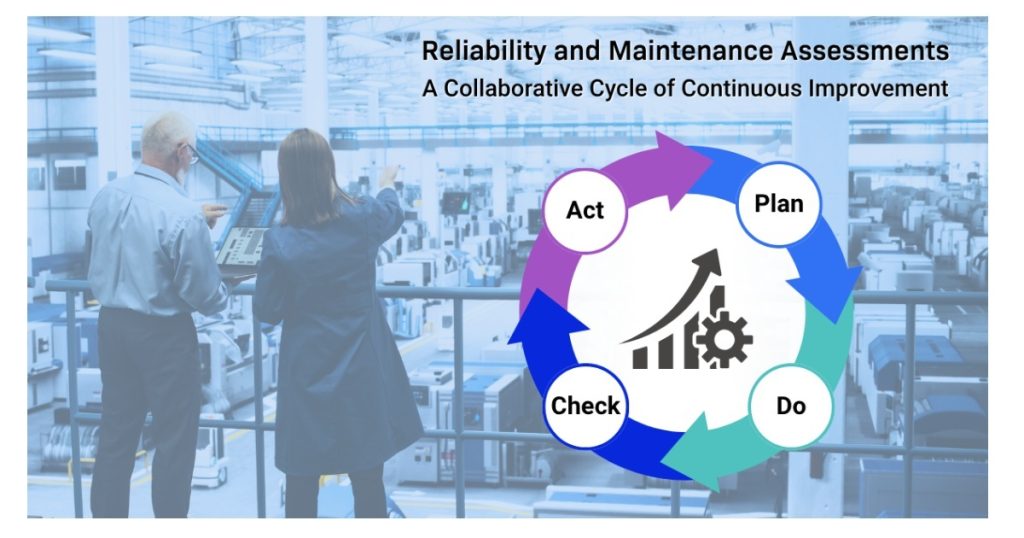
When a reliability and maintenance assessment is completed, the findings come in the form of risk-based reports and recommendations to improve the manufacturing line for optimized performance.
Assessment results advise manufacturers on:
- Implementing targeted recommendations
- Budgeting effectively for new projects
- Planning short and long-term implementations
Actionable short-term recommendations have a high impact and require less time to implement. For example, if an assessor identifies an obsolete part, they provide information such as part replacement and availability from suppliers.
Longer–term recommendations can drive change and reduce risk across your entire organization, which will involve adopting predictive maintenance strategies. Projects like new work procedures or redesigning and upgrading your manufacturing operation will significantly impact performance and your bottom line.
When manufacturers decide to make these types of changes, they can work with their assessor to schedule work during optimal times like weekends or when the operation is not running.
What Best Practices Mean to Today’s Reliability Engineering Experts

Companies conducting reliability and maintenance assessments must use global standards and practices like Lean Six Sigma and ISO 55000 Asset Management guidelines. Adhering to standards from the Society for Maintenance & Reliability Professionals (SMRP) is fundamental for conducting an assessment and will help ensure core principles are followed.
It is also ideal that the reliability engineers conducting your assessment have certifications from the SMRP such as the Certified Maintenance & Reliability Professionals (CMRP) program. This is a distinguished program designed to equip engineers with knowledge and proficiency that is acknowledged by reliability engineering experts.
Site involvement is a key differentiator for the quality of an assessment. By involving key stakeholders and experts from both the assessor team and the customer site, the more thorough your assessment will be.
Ensuring your implemented recommendations are sustained will require change management procedures like documenting and integrating them into your daily practices. Training your team on the new implementations and modifications will be important for the efficient functioning of the machine. Adopting an environment of open communication and feedback amongst teams and across the entire plant will also help sustain your new improvements.
Closing Thoughts
When taking a step back to look at the bigger picture, an assessment will emphasize the critical role of reliability and maintenance in operational efficiency and product quality. It also highlights how interconnected areas like governance, asset management, operations, material and resource management, system health, and continuous improvement play a vital role in reducing risks and enhancing performance.
By participating in an assessment, you will receive integral guidance for change management procedures like proper documentation, especially with aging equipment where historical knowledge may be lost. Without effective record-keeping and data analysis, manufacturers may unknowingly operate at suboptimal conditions due to past modifications that were never adjusted. This ties into the broader theme of continuous improvement, where assessments help organizations track, analyze, and optimize manufacturing processes.
Reliability and maintenance assessments provide proactive maintenance strategies to enhance efficiency in manufacturing environments. Ensuring resource management is optimized, whether through staffing adjustments or automation, will help enhance operational efficiency.
Ultimately, assessments help uncover inefficiencies, mitigate risks, and drive action for enhancement across multiple dimensions. This holistic approach ensures that manufacturers not only run their production lines at peak performance but also continuously evolve to meet industry demands.